Materials & Applications
Leavers vs Raschel Lace: Process, Structure and Sample Checks
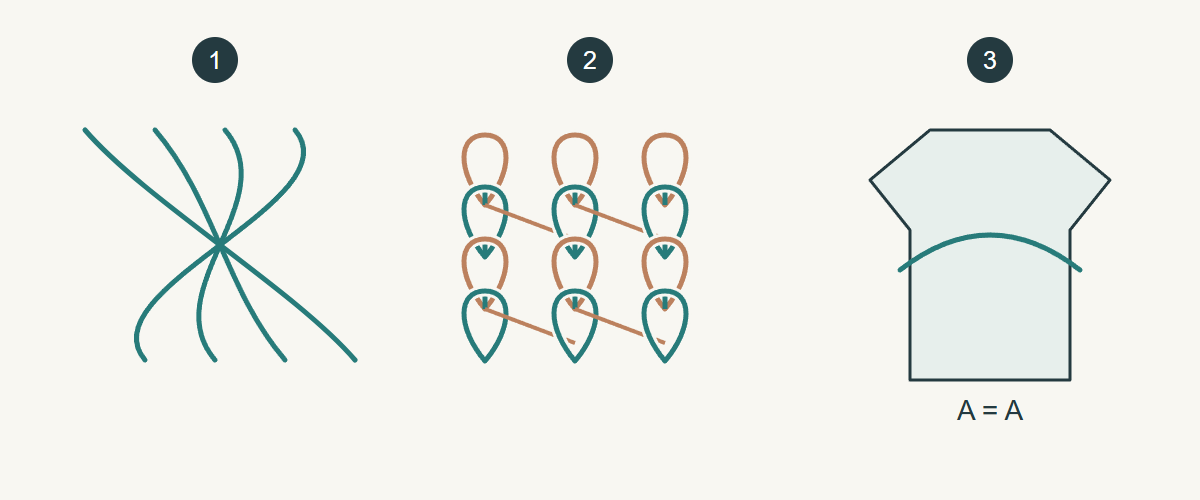
Leavers and Raschel identify different machine-making routes. Leavers lace is formed by complex thread interlacing; Raschel lace belongs to warp knitting, where yarn paths form knitted structures and patterns. Raschel can be elastic or rigid. A machine family helps explain construction, but cannot by itself establish softness, price value, provenance or fitness for a particular garment. Use the route to ask better questions, then compare the actual finished materials.
What changes in the manufacturing route
Solstiss documents its Leavers production and the specialist knowledge required to operate it. This is a machine process with substantial craft expertise, not handmade bobbin lace. KARL MAYER describes lace machines within its warp-knitting range. Its multibar systems use guide bars to control yarn placement. “Woven” is often used loosely in lace sales; when construction matters, ask for the actual route rather than relying on that word.
The illustration separates interlacing and loop formation at a conceptual level. It does not reproduce a Leavers threading arrangement or a Raschel lapping diagram. Real lace contains many interacting yarn systems. A drawing of a few threads cannot tell a technician how to run either machine and cannot identify an unknown sample by visual resemblance alone.
Why Raschel does not mean stretch lace
KARL MAYER’s Floral Diversity sample 2024/062 is explicitly described as non-stretch, on an MJ 92/1 F platform whose stated range includes elastic and rigid laces. That single counterexample is enough to reject “all Raschel stretches.” It is not a performance promise for another article or evidence that a rigid net is suitable for a fitted sleeve. Composition, structure and finishing still need confirmation.
Do not infer extension from elastane percentage either. Record the lengthwise and widthwise directions on the sample, the movement required by the pattern and the agreed evaluation conditions. A lace may open through its geometry without behaving like an elastic garment panel. If the assembly must extend, check the complete seam and underlayer, then its return after release; the less extensible component may control the garment.
Technical references
Read the ground and the motif separately
Under magnification, look at open ground, dense motif, outlining yarn and border. Photograph face and reverse with a scale and direction label. Knitted chains or an interlaced net are useful clues for a trained examiner, but finishing, embellishment and fine yarns can obscure them. If you cannot trace the yarn path, record the construction as supplier-declared until better evidence is available.
The useful question is what each part does in your panel. A delicate ground may be interrupted by dense, less yielding motifs. A heavy border may alter hanging even when the allover area is light. Assess a complete relevant repeat rather than the empty corner of a swatch. Do not pull out a thread from a reference or valuable sample to prove the machine type.
A comparison sheet that avoids a quality stereotype
Use the same buyer brief for both candidates. Record measured or observed facts beside declared information so an attractive story is not mistaken for a test. If origin or an identified production route is mandatory, close that documentary question before spending on garment trials. If the brief permits either route, judge the usable result without applying an automatic premium or discount to a machine name.
| Decision | Information needed | What the route cannot establish |
|---|---|---|
| Provenance | Maker, article, production declaration | A floral photograph proves origin |
| Fitted opening | Required direction, extension and recovery of assembly | Raschel automatically fits |
| Transparent overlay | Ground visibility, motif scale, chosen underlayer | Leavers automatically looks lighter |
| Cost | Accepted layout, usable width, finishing labour | Metre price alone proves value |
A hypothetical sleeve comparison
Suppose a stable occasionwear sleeve has a closure and sufficient pattern ease, so fabric stretch is not required. Candidate L is supplier-declared Leavers; R is a rigid Raschel. The designer wants a flower centred at the elbow and a border at the cuff. Both pass the paperwork requirement because the brief accepts either route. This is a planning scenario, not a customer case or measured product comparison.
Place the same sleeve pattern on a full repeat of each, with actual seam allowances. One candidate may position the cuff but leave an awkward broken motif at the sleeve seam. Compare the assembled bend and the reverse contact surface. If neither layout satisfies the design, alter the flower position, request another repeat or reconsider the border. Choosing the more prestigious machine name does not solve a placement conflict.
What to ask before accepting a substitute
Ask whether the substitute changes ground structure, motif repeat, border, composition or finishing. Similar face photographs do not prove the same cutting yield or seam behaviour. Keep sample revision and production declaration together. A route change is not automatically a rejection when the buyer permits alternatives; it reopens the checks affected by the new construction and the exact claims in the order.
Is Raschel always cheaper or less durable? There is no universal answer for finished articles with different yarns and decorations. Does Leavers prove French origin? The machine family and geographical claim are separate. Can either material be cut freely into motifs? Only a verified preparation and permanent attachment plan can establish that for the specific structure. Ask for enough material to test that operation before committing the whole panel.
Discuss your embroidery project
Send All4Lace the desired appearance, whether the manufacturing route is compulsory, the panel outline and movement requirement. Ask about current suitable embroidered or lace samples without treating Leavers or Raschel as an assumed factory capability.
Contact Zhijin