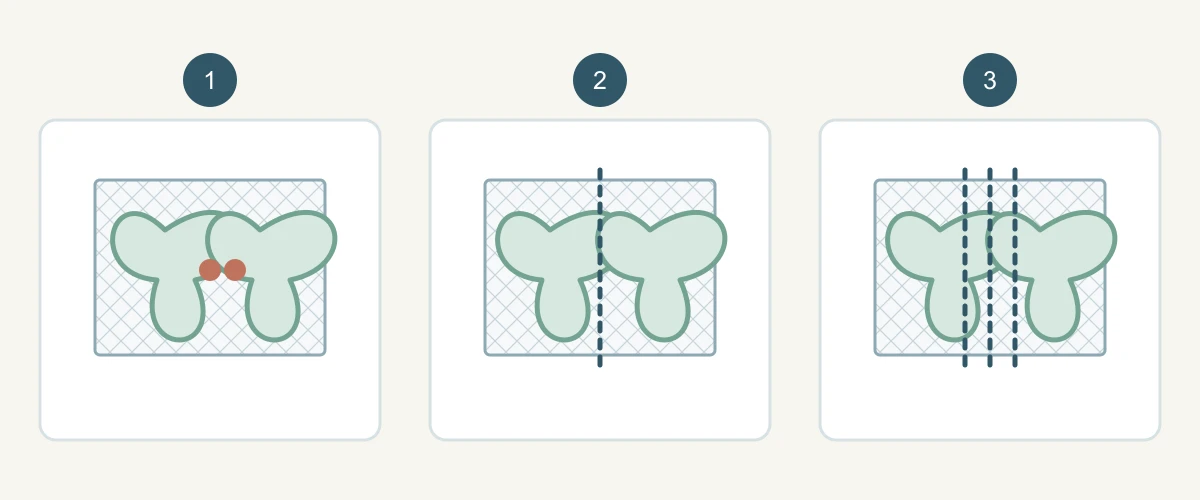
A flower that looks continuous on two flat pattern pieces can break abruptly after they are sewn. For embroidered or patterned lace, the buyer must decide where a motif should cross a visible seam, whether the repeat permits that placement and how much extra cloth the layout consumes. The decision belongs on a joined garment sample, not on two carefully arranged photographs.
Choose the seams that need a deliberate match
Start with the garment drawing. A centre-front opening, waist join and long skirt side seam do not have equal visual importance. Mark the seams that remain visible at normal viewing distance, then choose a small number of reference landmarks, such as a flower centre or a strong stem. A dense small repeat may need only a balanced rhythm; a large isolated motif may need a precise landmark at the front. Tell the supplier which expectation applies.
Match the same motif orientation across the pieces before comparing their edges. On directional lace, rotating a panel merely to force one flower into position can reverse leaves or change the apparent light. If a style contains mirrored left and right panels, record both sides separately. The goal is coherent garment appearance, not the mathematical alignment of every thread across every curved join.
Technical references
Work from the seamline rather than the cut edge
The Sewing and Craft Alliance pattern-marking guide locates the matching point at the seamline, not the cutting line. Draw each real sewing line on the pattern, including seam allowance and notches, then lay the pieces onto a full repeat of the candidate lace. A motif placed exactly on the raw edge will shift inward when the allowance is sewn. For a curved seam, compare several points along the stitch path rather than one point at its top.
Take a photograph showing the marked stitch lines, the complete adjacent repeat and the pattern orientation. Draw a numbered landmark on both joining pieces. This lets the cutting team reproduce the placement after the buyer leaves; a cropped photo of one perfect flower does not reveal what happens lower down the seam. Keep the paper or digital layout with the accepted sample.
| Layout item | What to record | Why it matters |
|---|---|---|
| Visible seam | Location and required viewing distance | Defines the priority |
| Motif landmark | Same numbered point on both stitch lines | Makes the match repeatable |
| Allowance | Cut line and actual sewing line | Prevents a false flat-layout match |
| Yield | Full repeat and unused fabric on each panel | Makes the quotation comparable |
Technical references
Price the matched layout, not a plain-area estimate
A large repeat can require moving one pattern piece down or across the cloth to meet the approved landmark. The Sewing and Craft Alliance explains this extra-yardage principle for stripes; the same planning question applies to a directional embroidered repeat, although its irregular flowers require their own layout. Request a full-width photograph with a ruler and the repeat boundaries, not a close-up with no scale.
Ask for a marker or paper layout that includes every size and left/right piece needed in the order. Count the metres consumed for that layout, including border placement and unusable gaps. A price per metre can look attractive while a seam-matched dress has poor yield. If only the front seam needs a close match, state that explicitly; otherwise a factory may price an impossible all-seams-perfect expectation.
Technical references
Approve a sewn junction in the planned layers
Pin or baste the chosen pieces along their marked seamlines, sew a representative segment and place it over the intended lining. Inspect the face and reverse in the garment’s hanging direction. The comparison should include the strongest motif, an open-ground interval and any border crossing the join. A layout that matches on a table may shift while the net feeds through a machine or while the garment hangs.
Record the result with a front view, a close view of the join and a note on whether an appliqué or motif overlap was deliberately used. Seamwork’s lace-hem tutorial shows how physical points on a border can act as alignment guides, but its hem construction is not a universal seam recipe. If the junction needs hand placement, put that labour and securing method into the approval record before bulk cutting.
Technical references
Answer the buyer’s practical questions in the brief
Must every flower be continuous? Usually the useful question is which seam and which landmark must appear continuous to the viewer. On a heavily curved seam, perfect continuity of all motifs may be unavailable without distorting the garment shape. Agree a priority zone and show any acceptable interruption in the signed sample. Do not stretch the lace until a flower meets its neighbour and call that a stable layout.
Can the supplier quote before a full dress is sewn? A provisional quote can use a scaled repeat and an identified cutting layout; final approval should follow a joined sample in the actual layers. Send the garment drawing, size range, direction of the lace, full repeat photograph, seam allowance, selected landmarks, target lining and planned order quantity. Ask for the proposed layout, estimated fabric consumption and the joined sample reference.
Discuss your embroidery project
Send All4Lace your pattern outline, the seam that matters most, motif landmarks, lining choice and full-repeat reference. We can discuss a sample and a layout that makes the intended match visible before the order is confirmed.
Contact Zhijin