Materials & Applications
Round vs Square Sequins: Coverage, Rotation and Edge Clearance
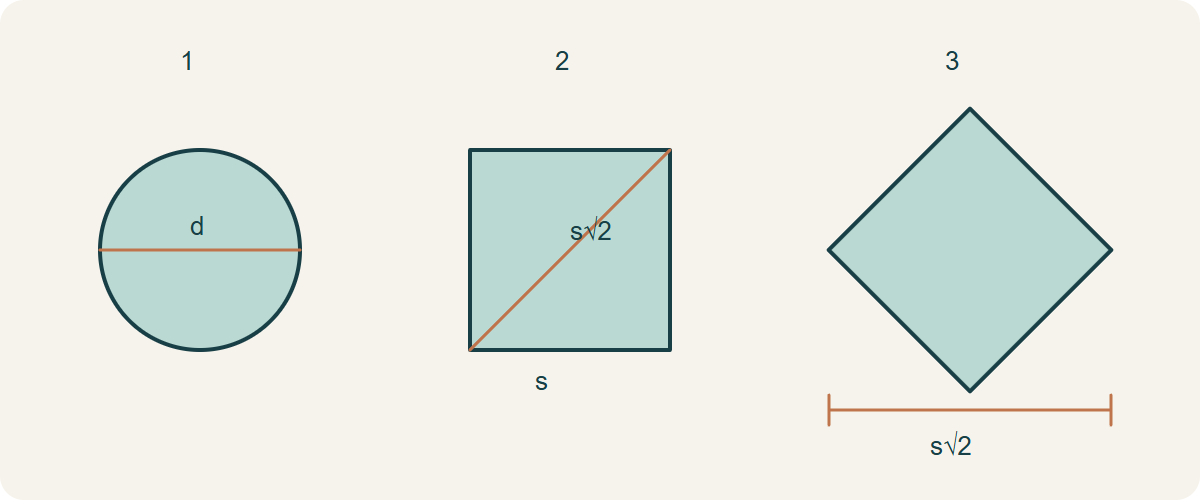
Round sequins have a curved perimeter; square sequins add corners and an orientation that can change their projected width. At an equal diameter or side length they do not have equal area. Choose by the finished surface and construction clearance, then compare matched stitched panels. Shape alone cannot establish sparkle, comfort, durability or a lower fabric cost.
1. Ask what the stated size measures
A catalogue entry called 5 mm can describe a round diameter, a square side or a maximum outer span. Record the actual definition and tolerance before comparing two quotes. Include thickness, corner form, hole location and whether the outline is flat or shaped. A square with rounded corners is geometrically different from an ideal sharp-corner square, even when both carry the same commercial label.
Manufacturers offer both shapes, and embroidery software treats the outline and fixing as editable variables. This establishes that shape is a deliberate component choice, not a quality grade. Keep the loose reference and the stitched reference together: a sample may look different because the fixing permits rotation rather than because the supplier delivered the wrong nominal shape.
Technical references
2. Separate ideal area from visible coverage
For an illustrative 5 mm diameter circle, ideal face area is π × 2.5², approximately 19.63 mm². For a 5 mm side square it is 25 mm². The square’s ideal area is about 27.3% larger, calculated as (25 ÷ 19.63 − 1) × 100. These are mathematical outlines before subtracting holes or rounding corners; they do not measure opacity, brightness or the number needed on a garment.
Coverage of an actual panel also depends on centre spacing, overlap, orientation, tilt and the visible ground between pieces. Adding all loose-piece areas can exceed the panel area when sequins overlap, so that sum is not a valid exposed coverage percentage. Compare photographs of equally sized finished panels, identify the exposed ground and state the viewing position if an appearance estimate is required.
3. Allow for a square’s changing outer span
An ideal square of side s has a diagonal s × √2. With a centred fixing, its farthest corner is s ÷ √2 from the centre. A 5 mm side square therefore has an approximately 7.07 mm diagonal and 3.54 mm corner reach, compared with the 2.5 mm radius of a 5 mm diameter circle. This matters when a corner can rotate towards a seam, opening or neighbouring piece.
Do not treat that geometry as an automatic spacing prescription. Fixing stitches can restrain rotation, and controlled overlap may be part of the design. Have the maker identify both the resting outline and permitted movement envelope. If the seam path lies inside either envelope, revise the placement or prepare a clear undecorated construction zone before cutting rather than hoping the needle will miss the corners.
4. Use a comparison panel that exposes the trade-off
Make the first comparison on the same ground, colour family, finish and nominal thickness, then record unavoidable differences. Compare equal panel area, not a handful of loose pieces. Use an additional panel if you want to compare equal piece count, because that answers a different question. One layout may show more background or require a different fixing path, which should stay visible in the review record.
| Comparison question | Keep explicit | Inspect on the finished sample |
|---|---|---|
| Which covers the intended area? | Panel size and anchor layout | Exposed ground, overlap and edge gaps |
| Which suits a geometric motif? | Square orientation and permitted rotation | Line continuity after handling |
| Which fits near an opening? | Resting outline and movement envelope | Corners or edges entering the working path |
5. Judge light and touch without shape stereotypes
A round outline does not guarantee soft sparkle, and square does not guarantee stronger reflections. Surface finish, curvature, faceting, transparency and light direction can dominate the effect. Observe the matched panels under diffuse light and the intended directional light, upright as well as flat. Keep exposure and camera position consistent; a clipped white highlight cannot reveal the structure beneath it.
For areas touching skin or another textile, assess actual edge condition, attachment and layer contact through the agreed movement. Square corners are locations to examine, not proof that all square sequins scratch. A rounded piece can also catch if lifted or damaged. If either sample catches adjacent lace, change the placement, edge treatment or component and repeat the assembly trial instead of judging the loose piece alone.
6. Do not infer cost from ideal area
The face-area calculation does not reveal reel feed yield, film utilization, machine speed, fixing stitch count or reject rate. A larger square area may need fewer pieces for one visual layout and more constrained orientation for another. Ask for comparable finished-panel specifications and a price that states the unit, usable width and decoration layout. Keep sampling, component and construction differences visible rather than hiding them in a shape surcharge.
If an order changes from round to square after pattern approval, review clearances, overlap and the finished light effect again. Retaining the same nominal size does not preserve the earlier geometry. A changed component should receive a new sample reference, and the garment maker should confirm that the revised surface still clears seams and closures before the quantity is released.
7. Three decisions the purchase record should preserve
Is a square measured by side or diagonal? Write the chosen definition. Must squares all face the same way? Specify the accepted orientation and whether movement is intentional. Can a supplier replace a discontinued round with a square of equal stated size? Only after a new comparison establishes that coverage, fixing and garment clearance remain acceptable; a size label is not an approved substitution rule.
Keep a labelled loose piece beside the approved panel and a dimensioned outline. Add a front, reverse and edge view so the next person can distinguish shape, attachment and overlap. When a later sample differs, compare those three records before deciding whether the cause is a changed component, rotated placement or a different fixing construction.
Discuss your embroidery project
For an All4Lace round-versus-square comparison, send the measured size definition, reference finish, target panel coverage and nearest seam or closure location. A small stitched panel will make the trade-offs visible.
Contact Zhijin