Materials & Applications
Tulle, Net and Mesh: Specify the Structure Behind the Name
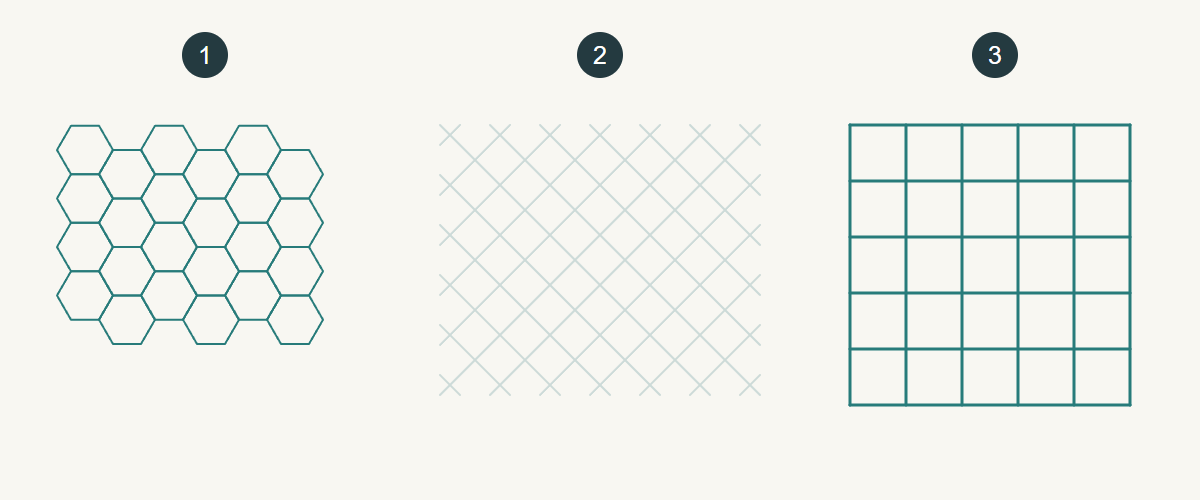
Tulle generally means a fine net fabric; net names an open network, and mesh is a broad description of an open structure. They overlap rather than form three mutually exclusive fibre types. A product called mesh can be fine, coarse, rigid or elastic; a tulle can be knitted or made by a bobbinet route. Specify the actual article’s construction and behaviour instead of assuming that one English word settles the fabric.
Why suppliers use the words differently
One seller may reserve “net” for firm petticoat material and “tulle” for soft veiling. Another lists both soft and stiff products under tulle. Heathcoat’s own fine tulle and dress-net range includes different handles and opening shapes; Swisstulle distinguishes genuine bobbinet and knitted textiles. These primary ranges are enough to reject a strict claim that every tulle is soft, hexagonal and warp knitted.
Keep the customer’s search term in a brief, but add a second line with observable requirements. For example: fine transparent net, low visible texture over the chosen backing, required lengthwise and widthwise movement, no embroidery yet. That wording allows a supplier to explain a differently named suitable candidate. It also prevents a familiar catalogue category from overriding a necessary property.
Describe the opening without pretending it is a fibre test
Photograph the relaxed net on a contrast background with a millimetre scale in the same plane. Note the supply direction and whether the opening is roughly hexagonal, diamond-shaped, square or irregular. Count openings along a marked span only if you also record the direction and relaxed state. Stretching a diamond can change its apparent width and height without changing the yarn itself.
Hole size does not prove airflow, snag resistance or strength. Those outcomes depend on the whole structure, yarn and finish, and often the underlayer. Nor does a hexagon identify nylon or polyester. For an appearance enquiry, a clear macro photograph and a physical sample are useful; where a performance requirement exists, agree a method applicable to that article rather than replacing it with a hole count.
A short specification beats three category labels
Keep construction, hand and movement in separate fields. A mechanically open structure may have give without the recovery needed for a fitted garment. “Rigid” in a product range usually distinguishes it from an elastic version; it does not mean a perfectly undeformable engineering sheet. Record how the actual fabric is allowed to move in the planned assembly.
| Field | Useful entry | Avoid assuming |
|---|---|---|
| Trade term | Tulle / net / mesh as quoted | Three exclusive materials |
| Construction | Supplier-declared route and reference | All fine nets are warp knit |
| Opening | Shape, scale, direction, relaxed state | One hole shape proves fibre |
| Hand | Candidate alongside intended layer | All net is stiff |
| Movement | Directions and whole-assembly requirement | Mesh necessarily stretches |
Test layers where the net will actually be used
A single layer over a black card shows yarn and openings clearly, but does not predict skin blending or privacy. Check the actual colour reference, the intended number of layers and any lace placed above it. Two fine nets can produce an interference pattern when overlaid. Rotate or shift spare layers to identify the effect, then judge it in the garment orientation rather than hiding it by a favourable photograph.
If embroidery is planned, evaluate the decorated trial as well as the undecorated net. A ground that looks nearly absent alone can show ripples, needle damage or changed openings after decoration. That is not resolved by renaming it illusion mesh. Keep an unembroidered control from the same sample and ask for a revised ground, support strategy or motif balance when the decorated structure fails the agreed appearance.
A hypothetical three-sample shortlist
Suppose a design team receives A called “soft net,” B called “bridal tulle” and C called “fine mesh.” The project is a transparent upper panel with lace appliqués, not an underskirt. The team compares identical-size spare pieces in the intended direction over one agreed colour reference. This is a proposed comparison, not a report of tested All4Lace fabrics.
A may blend visually but show an unacceptable seam ridge; B may be too visible in two layers; C may work only with a different permanent seam support. Record each failure at its location. Shortlist on the accepted assembled result, then confirm declared composition and current supply. If no candidate succeeds, change the panel or sample requirement; do not accept B merely because its name contains bridal.
Questions that names cannot answer
Does net fray? Some knitted or bobbinet structures do not fray like a plain-woven cloth, but cut strands, damaged loops, decoration and edge distortion still need inspection. Does soft tulle support a full skirt? Fullness depends on layer count, shape and the chosen hand, not softness alone. Is larger mesh always stronger? An opening photograph cannot establish breaking or bursting performance.
The practical deliverable is an identified ground sample with its direction, layers and intended assembly, plus the unresolved checks. A broad trade term is useful for finding candidates; the retained sample and written requirements are what make later comparisons meaningful. Review a substitute whenever its net structure, finish, colour or relevant dimension changes.
Discuss your embroidery project
For an All4Lace embroidery-ground enquiry, send a scale photograph, the intended panel, layer count, underlayer reference and movement requirement. Include any existing tulle, net or mesh sample code so its actual suitability can be discussed.
Contact Zhijin