Materials & Applications
Bobbin Lace vs Needle Lace: Identify Technique Without Damaging the Piece
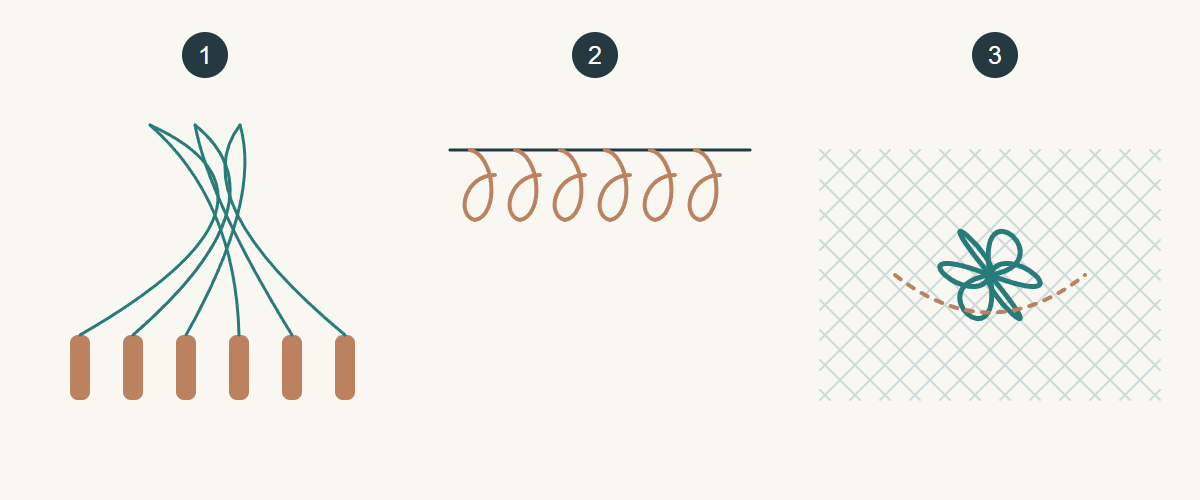
Bobbin lace is built by crossing, twisting or plaiting multiple threads held on bobbins. Needle lace is built with a threaded needle using linked stitches, commonly variations of buttonhole stitch. The difference is how the structure is made, not whether it has flowers, net or a scalloped edge. Some historical pieces combine techniques or apply separate motifs to a net. Identify components before trying to name the whole piece.
Follow how threads build the textile
In bobbin work, a pattern on a pillow guides many working threads, with pins supporting the developing structure. The thread groups cross and twist to build cloth-like areas and open grounds. A bobbin is a thread holder, not the small lower-thread bobbin of an ordinary sewing machine. In many European needle-lace styles, stitched areas develop against a temporary pattern or support and are released from it when finished. That is not a condition for all needle lace: Armenian needlelace can develop knots and loops directly from a retained fabric edge.
The Smithsonian’s collection overview distinguishes these working methods and explicitly allows combinations. The Lace Guild’s own introductory page identifies materials and equipment for both. These are sources for technique vocabulary. They do not provide a universal visual shortcut or a claim that every handmade lace has one thread throughout; joins, fillings and separate elements make a simple thread-count rule unreliable.
Inspect safely before making an attribution
Keep an old piece supported on a clean, smooth surface. Record its existing label and history before moving it. Take an overall photograph, then face and reverse details where handling is safe, with a scale alongside rather than pinned through it. Do not stretch holes open, cut a corner, pull threads, wash it or apply a burn test to identify technique. Seek a textile conservator where the piece is fragile or historically important.
Choose three areas to examine: the open ground, a dense motif and the join between them. Trace only what the photograph resolves. Repeating twisted pairs can suggest bobbin work; linked stitched bars or fillings can suggest needle work. Machine imitations, repairs and very fine threads can make those clues ambiguous. A careful record may correctly conclude “mixed or unresolved” rather than force a confident label.
Why a net ground does not settle the question
A net can be made with the motifs, or it can be a separate substrate carrying applied decoration. Smithsonian collections include mixed bobbin and needle work. The Met’s Chantilly record 03.1.2c identifies a specific piece as bobbin lace. Use such catalogued examples to compare terminology and visible structure, but do not transplant that attribution to an unrecorded sample merely because its flowers look similar.
Examine whether motif edges contain attachment stitches, an extra ground layer or repairs. Different sections of one garment may have been assembled at different dates. “Needle lace on machine-made net” and “machine embroidery on net” are not equivalent descriptions. The former can contain handmade stitched elements; the latter describes decoration stitched by a machine. Keep each visible component and its uncertainty in the record.
A practical identification record
Use descriptions before conclusions. Magnification should reveal structure rather than just sharpen a decorative silhouette. Record the observation, alternative explanation and missing evidence together. A machine-made net or an embroidered motif can imitate an older appearance; evenly repeated flowers are not enough to prove machine production, just as slight irregularity is not proof of handwork.
| Area | Record | Next evidence |
|---|---|---|
| Open ground | Visible crossings, twists or loops | Higher resolution face and reverse |
| Dense motif | Thread paths and relief | Comparable catalogued object or specialist |
| Motif/ground junction | Attachment stitches or continuous structure | Assembly history and detailed view |
| Whole piece | Existing label, repairs, provenance | Documentation tied to the object |
A hypothetical mixed-piece finding
Imagine a family collar with floral motifs and a regular net. A close view shows twisted thread pairs in one flower, but the net junction is hidden by later stitching. A second motif contains visibly different looped fillings. The reasonable initial description is “collar with at least two observed structures; ground and assembly unresolved.” This is an invented example, not a museum attribution or an All4Lace customer case.
Preserve the collar intact and ask a specialist whether the components are bobbin, needle or later repair. If the purpose is designing a new dress, separately describe the desired flower scale, openness and relief to a manufacturer. There is no need to declare a new machine-made interpretation handmade. An honest construction description protects both historical understanding and the new purchase specification.
Translate a historical look into a modern enquiry
For a new decorative fabric, separate the appearance reference from the required production route. Specify whether net should remain, which spaces must stay open, desired outline height, visible border and allowable movement. Ask for the actual offered method and component declaration. Traditional hand-made bobbin and needle lace are specialist crafts; this article does not state that All4Lace supplies either.
Which is better? Neither technique is a universal quality grade. Condition, construction and intended use govern a specific piece. Is needle lace the same as embroidery? Needle lace builds the lace structure; embroidery decorates a retained or removable substrate. Mixed pieces make that distinction less obvious to the eye, which is why the component-level record is more useful than a sales name alone.
Discuss your embroidery project
For a contemporary All4Lace decorative enquiry, send the look reference and mark the ground, motif, outline and border you want to retain. Ask what current sample construction can achieve those features; keep any request for traditional handwork explicit and separate.
Contact Zhijin