Materials & Applications
Denier, Tex and Dtex: Convert Yarn Count Without Confusing GSM
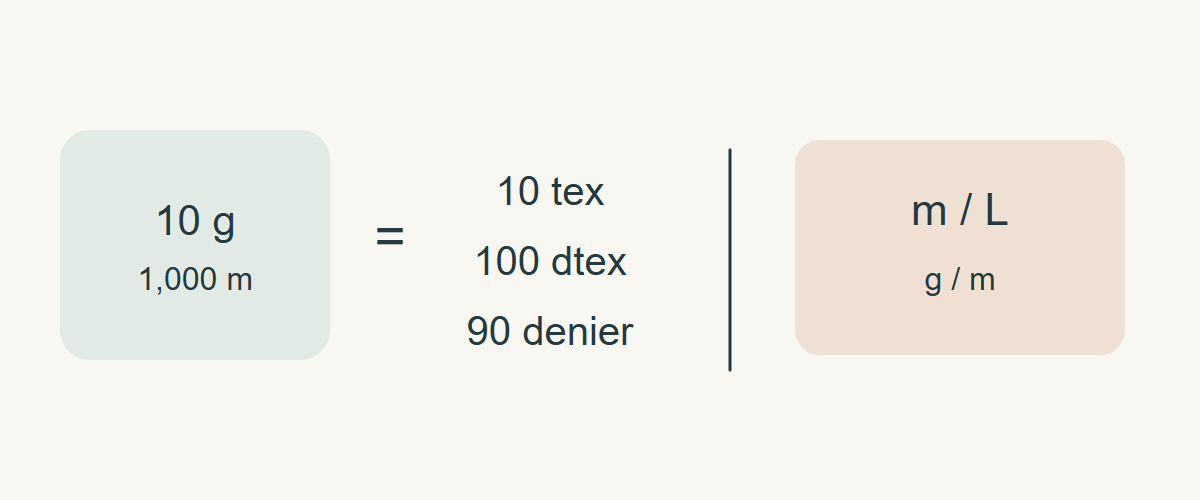
Denier, tex and dtex are direct linear-density units: they express yarn mass per specified length. Tex is grams per 1,000 metres; dtex is grams per 10,000 metres; denier is grams per 9,000 metres. Therefore denier = 9 × tex, dtex = 10 × tex, and dtex = denier × 10 ÷ 9. These conversions do not give fabric GSM, yarn diameter or finished lace strength.
Start from mass divided by length
Cotton Incorporated’s yarn-numbering bulletin distinguishes direct mass-per-length systems from indirect length-per-mass systems. In denier, tex and dtex, a larger number means more mass over the same reference length. That is the opposite numerical tendency from an indirect system such as metric count. Never compare a bare “30” with a bare “75”; the unit and the object being measured are part of the value.
If mass m is in grams and length L is in metres, tex = 1,000 × m ÷ L, dtex = 10,000 × m ÷ L, and denier = 9,000 × m ÷ L. These are unit definitions applied arithmetically. Measuring a commercial yarn requires controlled preparation, mass and length conditions; the equations alone do not make a casual ruler-and-scale exercise a standard test.
Keep a small conversion table with the quotation
Convert only values that describe the same yarn scope: the whole supplied yarn, a constituent end or one filament. Keep extra precision in the calculation and round only the reported result to an agreed precision. Repeated rounding can make equivalent nominal values appear different. A supplier’s rounded commercial designation and a measured result may also differ within the context of an agreed specification.
| Known value | Tex | Dtex | Denier |
|---|---|---|---|
| 75 denier | 8.333… | 83.333… | 75 |
| 100 dtex | 10 | 100 | 90 |
| 20 tex | 20 | 200 | 180 |
A worked example you can reverse-check
Hypothetical example: a prepared 500 m yarn specimen has a recorded mass of 5.00 g under the stated measurement conditions. Its calculated linear density is 1,000 × 5.00 ÷ 500 = 10 tex. The same mass-per-length ratio gives 100 dtex and 90 denier. The specimen and figures are invented to demonstrate the units, not results from an All4Lace yarn or an accredited test.
Reverse-check the answer: 10 tex means 10 g per 1,000 m, so 500 m should weigh 5 g under the same basis. A calculation yielding 100 tex for these inputs is off by a factor of ten. Before changing a yarn purchase, check whether the source length was metres or kilometres and whether the mass was grams rather than kilograms. Unit errors are not product differences.
Distinguish yarn total from individual filaments
A filament yarn may be described by total linear density and a filament count. If a hypothetical 75-denier yarn contains 36 equal filaments, the nominal denier per filament is 75 ÷ 36 = 2.083… . This averaging only applies under the equal-filament assumption; it is not a microscope measurement of each filament and not a statement about spun-yarn fibre counts.
Two yarns with the same total denier but different filament counts can have different surfaces and bending behaviour. Texture, twist, cross-section and finish also matter. Do not infer softness, transparency or embroidery coverage solely from total denier or denier per filament. Keep a physical yarn or decorated reference when that surface matters to the project.
Read slash notation before multiplying
Ply notation is not completely uniform across suppliers. Ask whether “75D/2” means two 75-denier constituents or a combined 75-denier yarn, and request the finished total linear density. Under the explicitly stated first convention, two 75-denier ends would give approximately 150 denier before allowing for twist contraction and processing changes. Do not silently apply that convention to every label.
Cotton Incorporated explicitly notes that some systems quote a constituent and others the assembly. An enquiry should preserve the original designation, the clarified meaning and the normalized total in separate columns. This prevents a nominal conversion from doubling or halving the actual thread ordered. For elastic, covered or fancy yarn, ask how the supplied condition and components are represented rather than estimating from an isolated core.
Technical references
Why this does not give fabric GSM or a test certificate
GSM is mass per area, not mass per yarn length. Finished embroidered fabric includes different yarn lengths, ground, retained support, decorations and finish. Converting 75 denier to 8.333 tex says nothing about how many metres of that yarn occur in one square metre of fabric. Needles and stitch coverage also require the actual material and machine context; linear density alone is not a stitch-setting instruction.
ISO 1144’s public description covers the Tex System and conversion principles. ASTM D1907/D1907M’s public scope concerns determining yarn linear density by a skein method with applicability conditions. Only the public scope is used here; no paid procedural parameters or acceptance tolerances are invented. For formal verification, identify the current agreed method, specimen condition and reporting scope with the testing party.
Discuss your embroidery project
For an All4Lace embroidery enquiry, send the original yarn designation, unit, ply or filament information and the desired finished effect. Attach a reference sample where possible; a converted number helps clarification but does not replace the decorated sample.
Contact Zhijin