Customization & Sampling
Cutting Lace on Grain or on the Bias: Separate Structure from Motif
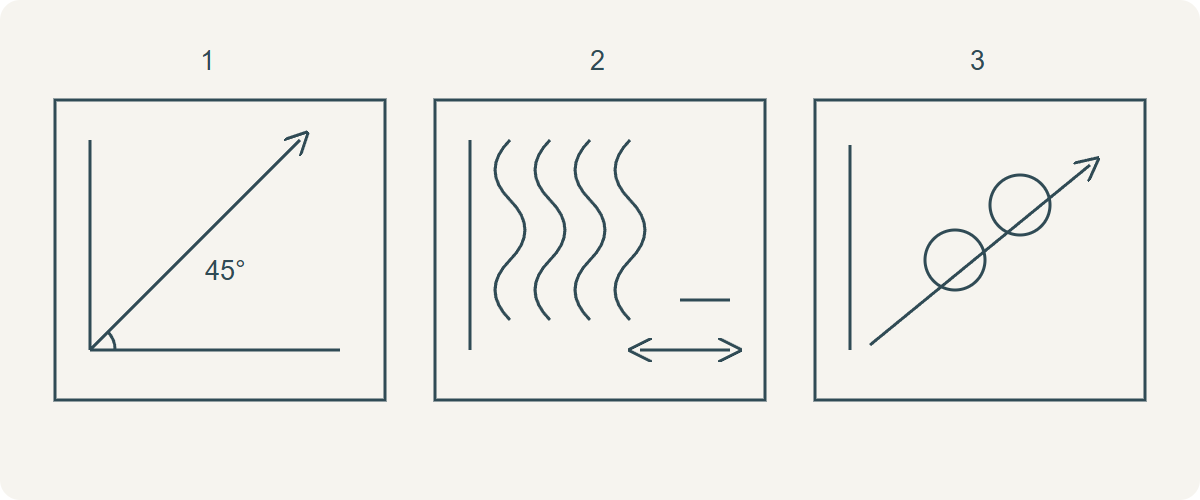
Do not cut lace on the bias merely because it is sheer. For a woven ground, true bias is 45° to warp and weft; for knitted lace, inspect its loop structure and required stretch direction instead of importing that woven rule. Mark the ground direction, movement and motif orientation separately, then follow a pattern designed for that behaviour. Rotating a pattern to use a scalloped border changes more than the appearance.
Draw three arrows, not one
Label a lengthwise structural reference L, the direction of required extension E, and the decorative “up” M. They may align, but alignment is something to establish on the sample. A flower stem can run diagonally over a straight net; an embroidered grid is not necessarily the ground’s construction line. Inspect the reverse and an undecorated margin where possible, and ask the supplier for the ground construction when it is obscured.
Treat the straight roll edge as a locating aid, not conclusive proof of a straight structural line. A relaxed sample can have bowed rows or a skewed border. If a visible flower and the identified ground cannot both align with the pattern, record the conflict before cutting. Pulling the material square under a weight or pin does not prove it will stay square in wear.
Use the bias definition only for a woven structure
BERNINA’s woven-grain reference defines the lengthwise and crosswise axes and true bias between them. Its drawing helps explain a woven organza ground carrying embroidery. An unsupported bias edge can change as it is handled; a pattern drafted for bias drape accounts for behaviour that a straight-grain pattern may not. Rotating the latter by 45° is a design alteration requiring a fit and construction trial.
Do not use visible drape as proof that a fabric is woven, or that a diagonal orientation is correct. Embroidery can restrain one area while a light ground yields beside it. For a woven candidate, check the intended panel in its proposed orientation with the same lining and seam support rather than assuming a textbook bias response will be uniform across decorated and clear areas.
Technical references
For knitted lace, find the actual movement
CottonWorks explains knitting through intermeshed loops, including different knitting routes. That structural starting point differs from woven warp and weft. The largest extension may not be the direction suggested by a flower. Compare lengthwise, crosswise and any proposed diagonal on labelled spare pieces; use the same defined handling and observe recovery, not just the easiest pull. This workshop comparison is not a standard elasticity test.
If the pattern requires extension around the body, mark that requirement on each piece and confirm the selected orientation supplies it without permanent distortion or an unsuitable motif. When it cannot, change the ground, layout or pattern. A diagonal cut does not create a specified stretch percentage or make an incompatible knit suitable for a fitted bodice.
Technical references
Compare orientation on a garment-relevant trial
Use spare material large enough to include the influential motif and the longest unsupported edge of concern. Transfer an identical panel outline and reference marks to each proposed orientation without pulling the ground into shape. Include its planned seam, underlayer and edge finish. Suspend or support each trial as that garment part will be used, then compare in the same relaxed state.
If the hem drops unevenly, inspect direction and handling before removing length. Trimming an unstable trial to look level can conceal continued movement. If a diagonal panel twists while the straight version remains balanced in this setup, retain that observation with its conditions; it does not establish that every diagonal lace panel will fail.
Resolve a border conflict before buying
Hypothetical example: a skirt pattern requires its marked axis parallel to L, while a desired scallop is only available along a roll edge that would rotate the skirt piece by 90°. Do not silently accept the rotation. First trial the crosswise behaviour; if it fails the garment’s movement or hang, retain the structural orientation and consider a separately applied border, subject to its own attachment trial.
A separately applied border adds joining work and consumes matching material. It may also place a seam where the design requires an uninterrupted transparent area. Where that trade-off is unacceptable, request another lace construction or change the garment design. None of these choices can be settled by a small photograph of a scallop.
| Observation | Do not infer | Next action |
|---|---|---|
| Woven ground, diagonal pattern | Any lace needs bias cutting | Confirm bias-designed pattern and complete trial |
| Knitted ground, transverse movement | Motif shows extension direction | Label actual extension and recovery |
| Border conflicts with grainline | Rotate freely to save cloth | Compare rotated trial or separate border |
| Ground reference cannot be found | Roll edge guarantees alignment | Request construction information and larger sample |
Lock the approved direction into the cutting record
Once an orientation is accepted, measure from both ends of the paper grainline to a verified parallel reference. Distances must match for a parallel placement; measuring only at one point lets the paper rotate unnoticed. Use full single-layer patterns for clear motif placement and remember left/right handed pieces. Keep paper orientation and fabric face labelled while turning the paper for a mirrored pair.
Record the material reference, ground direction, E and M arrows, pattern revision, seam support and accepted trial. Recheck after a change to ground, motif density or finishing, because keeping the same flower outline does not establish the same directional behaviour. Offcuts can help document the reference, but an unlabelled diagonal scrap is not a replacement for the approved layout.
Technical references
Discuss your embroidery project
For an All4Lace cutting-layout discussion, send the actual pattern grainlines, intended movement, usable-width requirement and border position. Request a sample large enough to include the relevant ground and full repeat before planning a cut length.
Contact Zhijin