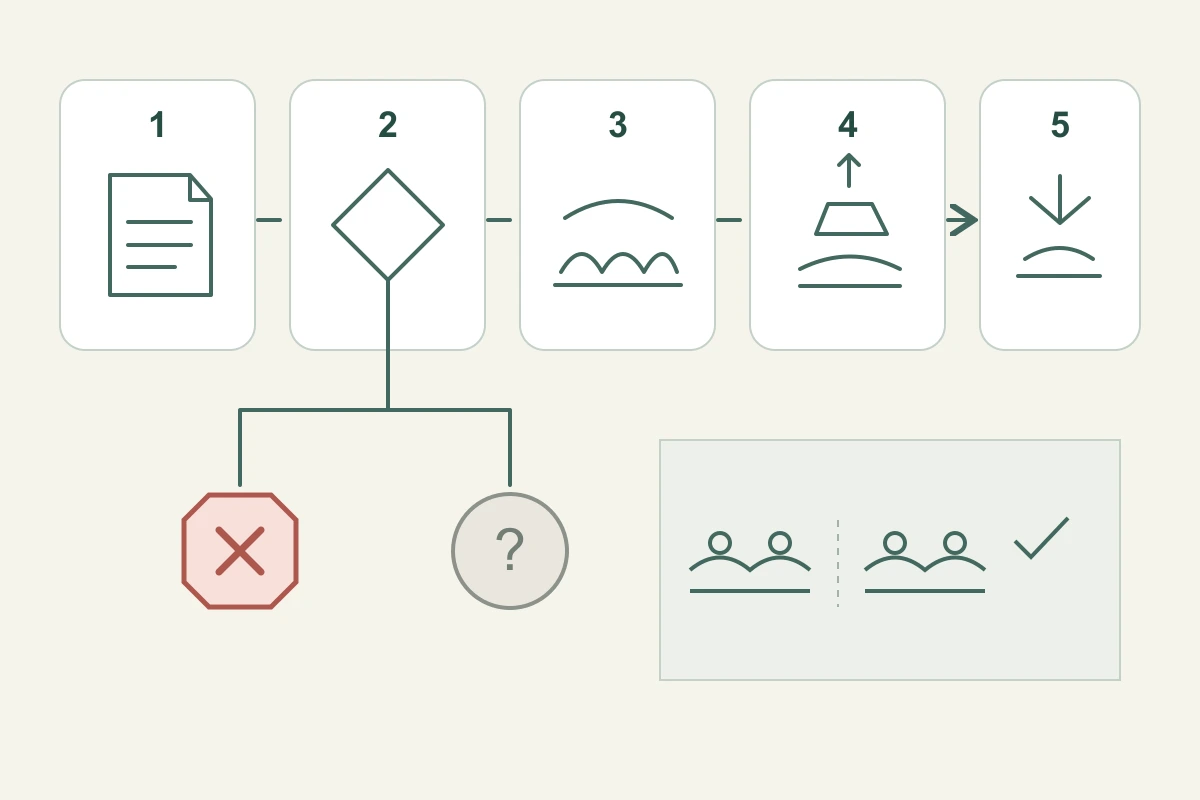
Do not choose an iron setting from the words lace, polyester or sequin. First establish whether pressing is permitted for the actual assembled materials, including decoration and lining. If permission is missing or contradictory, pause and obtain the relevant instructions. When pressing is supported, develop the handling on a representative offcut before approaching a garment panel. This guide addresses that decision and sequence, rather than assigning one heat or steam recipe to decorated fabrics.
1. Establish which care information applies
GINETEX states that care limits concern the critical parts of the article, including finishes, accessories and applications. Its ironing guidance bases the maximum setting on the care label, not fibre content, and calls attention to raised effects and applied decoration. Accordingly, check the instructions for the chosen assembly, not just an undecorated ground.
Identify the embroidery thread, sequins, beads, attached motifs, lining and any bonding involved in the area to be pressed. Match available instructions to those actual components and the current construction. Information for another finish or a fabric before decoration does not resolve the finished combination.
2. Choose the stop, clarification or trial branch
If applicable instructions prohibit ironing, do not start an ironing trial. Do not treat hovering steam as an automatic alternative: check whether it is permitted separately. For an unclear symbol, missing assembly information or conflicting component instructions, stop and ask the garment maker or supplier to clarify the relevant restriction.
Where instructions require specialist treatment, or the garment team cannot establish a supported route, refer the work to an appropriate professional with the material information. A low setting and a press cloth do not turn an unsupported process into an approved one. Read steam restrictions explicitly; this guide does not translate dot counts into a steam rule. A professional-cleaning symbol alone does not permit ironing.
Technical references
3. Separate a flat ground from raised decoration
Name the defect you want to correct. A crease in an exposed ground between motifs is a different target from a folded three-dimensional flower or a raised bead cluster. Pressing the entire area flat may conflict with the intended relief even when the base needs smoothing.
Map where the proposed contact and support would meet the decoration. If the ground cannot be reached without loading the raised elements, stop that route and seek a suitable finishing approach. Working from the reverse alone does not establish protection: raised parts can still be trapped against the support.
4. Prepare a representative trial and its support
Use an offcut of the same selected material with representative dense and open decoration. Include the actual seam, lining or attachment layers if the operation will involve them. Keep an untreated portion for comparison. An undecorated scrap cannot answer what happens to the decorated assembly.
Choose a clean support that accommodates the relief without snagging or flattening it, and trial that arrangement first. If the applicable method calls for an intermediate cloth, include the chosen cloth in the trial. It does not remove pressure, moisture or heat restrictions. Select conditions from applicable care and equipment instructions; no universal temperature, steam quantity or contact time is supplied here.
5. Lift, place and let the sample cool
With the trial fully supported and positioned without tension, apply only the permitted operation to a small area. Lift and replace the iron rather than dragging it across motifs or pulling the mesh. Avoid using repeated passes as a substitute for resolving an unsuitable setup.
Leave the sample supported until it has cooled naturally before moving, stretching or judging it. Compare it with the untreated area in similar light. Inspect both faces and the profile of the decoration, then examine the relevant seam or layered area. Do not judge success solely from a flatter ground while the sample is still warm.
6. Read the result before repeating the operation
Use these distinctions to decide the next action. They identify observations to investigate, not a diagnosis of a fibre or coating. If a change appears, stop instead of escalating heat or steam to chase the crease. A visually acceptable offcut supports discussion of that combination only; it is not product certification.
| Observation after cooling | Decision before another attempt |
|---|---|
| Ground remains creased; decoration unchanged | Recheck target, permitted method and support; do not increase treatment automatically. |
| Relief is flattened or decoration marks the ground | Stop; review contact and support before considering a revised sample. |
| Gloss, colour transfer, distortion or attachment change | Stop; seek material-specific advice and preserve the changed sample. |
| Ground and decoration meet the agreed appearance | Retain the exact trial arrangement; review again if assembly or materials change. |
Discuss your embroidery project
Send All4Lace the selected reference, face and reverse close-ups, intended garment layers and available care instructions when requesting a sample for pressing review. Mark whether the target is the ground or a raised decorative area.
Contact Zhijin