Customization & Sampling
Half-Drop Repeats in Sequin Fabric: Mapping Columns Before Cutting
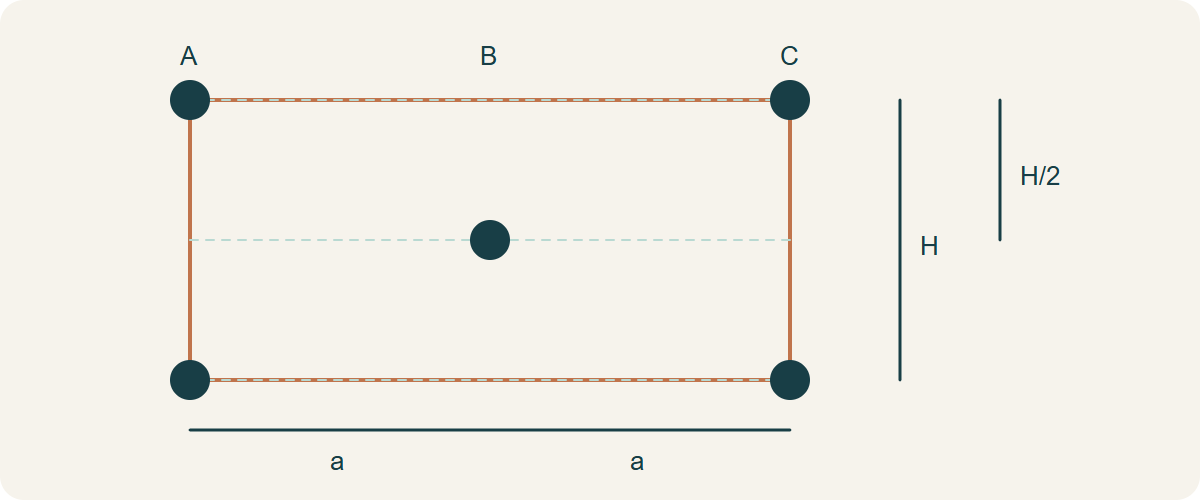
In a simple half-drop repeat, neighbouring motif columns are shifted by half the vertical repeat. The same motif returns at the same phase two columns across. Measure that relationship on the actual fabric before matching seams: a short sample can hide the offset. For sequins or embroidery, also preserve face, light direction and permitted cutting orientation; a geometrically matched motif can still look different after rotation.
1. Measure the offset rather than guessing from diagonals
Pick an unmistakable landmark within one motif and mark several copies down the same column. The vertical distance between equivalent landmarks in that column is H. Move to the neighbouring repeated column and measure its horizontal spacing a and its vertical offset relative to the first. A half-drop relationship has an offset of H/2, subject to the actual agreed dimensional tolerances. A diagonal-looking pattern alone does not establish that relationship.
Original designer tutorials show half-drop and straight repeat as different arrangements, while repeat-design software distinguishes half-drop from brick layouts. In the simple convention used here, the offset runs vertically between columns; a half-brick shifts horizontally between rows. Suppliers can use different wording, so send a marked photograph and dimensions rather than asking only whether the fabric is half drop.
2. Distinguish motif spacing from a rectangular repeat tile
For a generic simple half-drop with no additional symmetry, translations by (a, H/2) and (0, H) reproduce the layout. A convenient axis-aligned rectangular tile spans 2a in width and H in height, because two half-offsets return to the same vertical phase. That rectangle contains two neighbouring column phases. Calling a × H the rectangular repeat would omit the alternating relationship at its side edges.
This is not a claim that every real design has a smallest tile of 2a × H. A primitive slanted cell can describe the same lattice, and additional identical features or symmetries can produce a smaller effective visual repeat. Conversely, alternating colours, thread details or sequin orientation can enlarge the complete-design repeat beyond a repeated silhouette. Validate the whole motif, not just one easy-to-spot circle, against the approved artwork and actual width.
3. Work through a coordinate example
Hypothetical layout: a = 300 mm and H = 400 mm, with identical motifs and no extra colour alternation. Column A has landmarks at y = 0, 400, 800 mm. Column B, 300 mm across, has equivalent landmarks at y = 200, 600, 1,000 mm. Column C, another 300 mm across, returns to y = 0, 400, 800 mm. The offset is 200 mm, and a convenient rectangular tile is 600 × 400 mm.
A swatch showing only A and the top of B might suggest a missing motif, while a swatch showing only one column cannot prove the horizontal relationship at all. Request enough fabric or a dimensioned full-repeat drawing to show both phases and their return. The coordinates are a schematic example, not the dimensions of an All4Lace product; the actual piece may have a border, different repeat or another colour sequence.
| Column | x position | Equivalent y landmarks | Phase |
|---|---|---|---|
| A | 0 mm | 0, 400, 800 mm | 0 |
| B | 300 mm | 200, 600, 1,000 mm | H/2 = 200 mm |
| C | 600 mm | 0, 400, 800 mm | Returns to 0 |
4. Match the finished seam line, not the cut edge
Place the actual garment patterns on a repeat map and mark intended join lines inside the seam allowances. Compare equivalent landmarks at those join lines. Aligning cut edges alone shifts the apparent match when allowances are consumed. If adjacent pieces originate from different column phases, shift them to the appropriate phase while retaining the required length direction; do not rotate a directional sequin panel just to make one landmark meet.
A shaped side seam or dart cannot usually match every point of a two-dimensional repeat after the garment gains volume. Choose priority match locations with the garment maker, such as a waist crossing or visible centre seam, and record acceptable breaks elsewhere. Mirror symmetry is another requirement and may not exist in the original pattern; a half-drop does not automatically provide left/right mirrored motifs. Trial the chosen priority junction with the real layers.
5. Usable width changes the available phases
Full-width edges need not land on equivalent columns. If the usable width spans an odd number of a intervals in the simple layout, opposite edges can be half a vertical repeat out of phase; a span of two a intervals returns to the same phase. Real edges may fall between columns or include different borders, so count neither rule blindly. Inspect the actual edge landmarks and usable boundaries on the sample.
For long rectangular panels, an original curtain-cutting tutorial demonstrates grouping phases to reduce repeated positioning waste. That is a useful planning idea, not a ready-made garment consumption formula. Shaped pieces, sizes, borders and light direction can prevent the same arrangement. Use a scaled marker at the actual usable width, label phase and orientation for every piece, and confirm the full marker rather than multiplying a generic repeat allowance by garment count.
Technical references
6. Estimate consumption from the approved marker
A half-drop does not automatically double the fabric requirement. Extra consumption depends on where the first piece starts, which phases are needed, the shapes and sizes, whether pieces can nest, and any prohibited rotations. Make a trial marker containing the complete size mix, count garments, and divide marker length by that count. Then identify any additional loss not already represented, such as roll ends or excluded defects, before applying an allowance.
Retain the repeat map, marker revision and a joined sample of the priority seam. If later goods have a changed repeat, do not stretch them to fit the original marker or average measurements from two incompatible lots. Recheck the actual phases, usable width and layout, then agree whether the new lot is acceptable. A photograph of a small isolated motif cannot establish that the full half-drop relationship remains unchanged.
7. Questions to include in the sample request
Does the stated repeat mean the same-column vertical H, the offset H/2 or a full rectangular tile? Ask explicitly. Can the fabric be turned 180 degrees? Only if the approved design and surface effect allow it. Is a half-drop itself bow or skew? No; an intentional offset and unwanted distortion are different, although both can exist in one material and need separate reference checks.
Request a full-repeat view that shows both width and length, a usable-width definition, direction marks and the priority garment seam. Those four items let a pattern maker test the layout independently. The accepted marker and physical junction provide stronger evidence of usable matching than a claim that a design is easy to match or a percentage added without a layout.
Discuss your embroidery project
Send All4Lace a marked repeat photograph, column spacing and vertical repeat if known, usable width and the garment seam that needs matching. Ask for enough reference to show both half-drop phases.
Contact Zhijin