Materials & Applications
Embroidery Fabric Weight: What GSM Measures and How to Calculate It
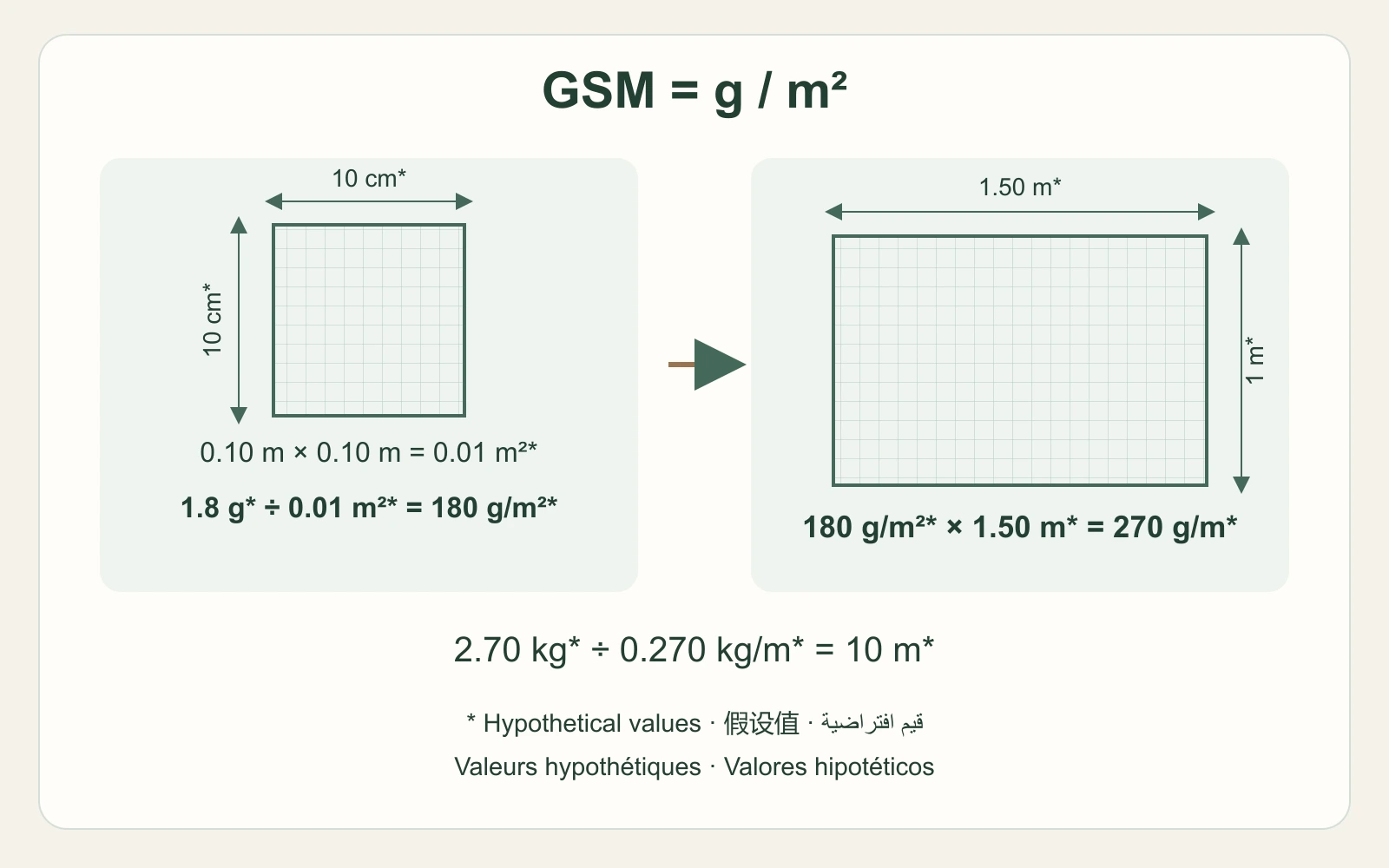
GSM means grams per square metre: fabric mass in grams divided by the area in square metres. For embroidered fabric, specify whether that mass covers the finished ground and attached decoration, or only a particular component. GSM helps compare material quantities over the same area. To turn it into mass per linear metre, you also need the width and a representative area basis. A heavier figure alone is not a quality grade.
Calculate area first, then divide the net mass
For a rectangular specimen, area equals length in metres multiplied by width in metres. In a hypothetical example, a 10 cm × 10 cm square is 0.10 m × 0.10 m = 0.01 m². If its net fabric mass is assumed to be 1.8 g, the calculation is 1.8 g ÷ 0.01 m² = 180 g/m². Multiplying by 100 works here because this particular area is one hundredth of a square metre.
Keep the measured area and mass together in the record. Check the specimen dimensions in its agreed state, without stretching it to fit a nominal square. For the finished embroidered material, identify included ground, stitching, attached decoration and any retained support. Record a separately supplied lining as its own component rather than silently adding it to the figure.
Convert to a linear metre using the same width basis
For a uniform rectangular material, mass per linear metre equals representative GSM multiplied by width in metres. Continuing the hypothetical example, assume 180 g/m² is representative of the same full-width area and that this width is 1.50 m. Then 180 g/m² × 1.50 m = 270 g per linear metre. This arithmetic excludes packaging and accessories added separately.
Choose full width or usable width consistently. If the average includes a decorated border and selvedges, use that same area boundary for the width. A central swatch without the border cannot simply be multiplied by full width to obtain an exact delivery mass. ISO 3801 addresses woven fabric mass by area and length and highlights the importance of structural differences in relating them.
| Quantity | Basis | Hypothetical example |
|---|---|---|
| GSM | Net mass ÷ sampled area | 1.8 g ÷ 0.01 m² = 180 g/m² |
| Mass per linear metre | Representative GSM × matching width | 180 g/m² × 1.50 m = 270 g/m |
| Length from net mass | Net mass ÷ matching mass per metre | 2.70 kg ÷ 0.270 kg/m = 10 m |
Make the sample reflect the decoration layout
Embroidery can alternate dense motifs, open ground and border decoration. A small square centred on a flower and another cut from an open area describe different local zones. Map the repeat and the width before agreeing where to take specimens. Include the relevant decorated and open regions in the sampling plan; identify border and selvedge inclusion explicitly.
ASTM D3776 distinguishes full-width and small-swatch approaches; its public abstract limits small-swatch results to that sample rather than automatically to a lot. For a whole-width estimate, agree a representative width-and-length coverage and how local results will be combined. Keep each location and area in the record so a later comparison uses the same coverage.
Agree conditioning and a net-weighing procedure
Agree the sample state and conditioning approach before comparing results. ISO 139 covers atmospheres for textile conditioning and testing. Ask the responsible laboratory to select an applicable method, atmosphere and equilibration procedure for the material; record what was used. A convenient room reading and a conditioned laboratory result should carry different descriptions in the sample file.
Use a suitable verified balance with resolution appropriate to the specimen mass. Following its instructions, zero it, tare any empty weighing container, add the fabric and record the stable net reading in grams. Preserve the raw reading and instrument information. Taring removes the container contribution from the reading; it does not establish sample representativeness or replace an agreed test method.
Use the result for a defined decision
For a hypothetical net fabric mass of 2.70 kg, the same uniform 180 g/m² material at the matching 1.50 m width gives 2.70 ÷ 0.270 = 10 linear metres. Changing the width or the representative mass per metre changes that conversion. Exclude roll cores and packaging, and keep the same component boundary throughout the calculation.
When selecting a garment material, compare GSM alongside motif distribution, hand, transparency, drape and the intended assembly. Two samples with the same area mass may place their decoration differently. Use a weight target to control a defined specification, then review the actual material for the garment instead of ranking all embroidered fabrics from light to heavy.
Keep a comparison record with the number
A useful record lets another person reconstruct the calculation and identify the material area it represents. Agree the target and any tolerance with the buyer and testing team for the particular specification.
- Identify the sample and finished components included in its mass.
- Record specimen location, dimensions, area and repeat coverage.
- State whether borders and selvedges are included.
- Keep conditioning, balance, tare and raw net-mass records.
- Attach the matching width basis to any per-metre conversion.
- Separate hypothetical estimates from recorded measurement results.
Discuss your embroidery project
Send All4Lace your material reference, intended garment use and required weight basis—GSM or mass per linear metre—together with width, decoration layout and quantity, so we can clarify a representative sample specification.
Contact Zhijin