Materials & Applications
Guipure Lace Fabric: Names, Connecting Bars and Garment Placement
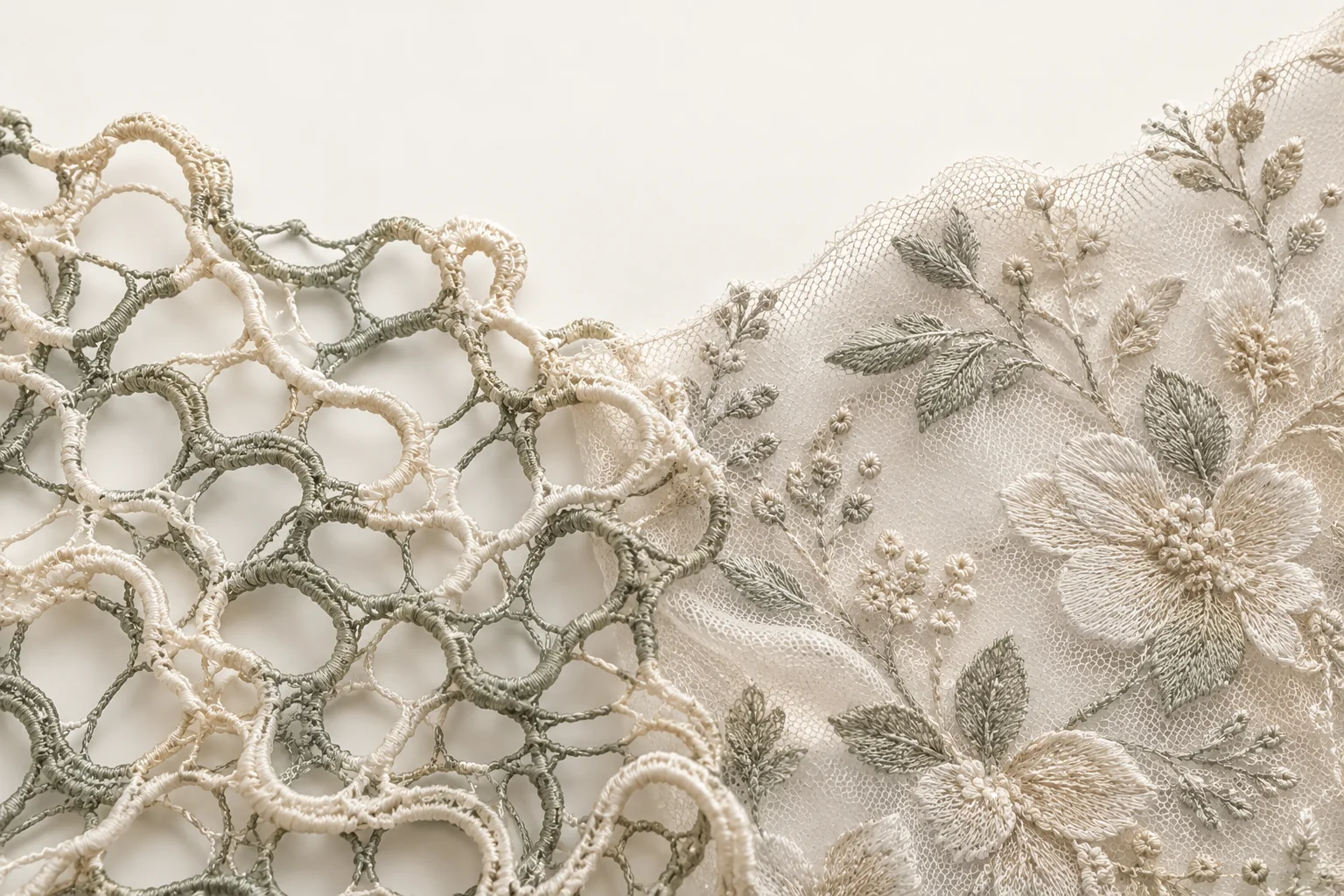
Guipure-style lace is recognised by motifs joined through connecting threads or bars rather than a continuous net ground. For a buyer, the next step is to trace how the flowers, leaves or geometric shapes join and then position the repeat on the garment. The connection layout, motif scale and planned cut lines are separate decisions. Establish them together before deciding on a lining or requesting detached flowers.
What do guipure, Venise and Venetian tell you?
Museum collections distinguish bobbin guipure from Venetian needle lace. These historical categories show why guipure, Venise and Venetian should not be treated as interchangeable process certificates. In a current quotation, have the supplier describe the offered construction explicitly. The V&A uses gros point de Venise for a specific historical needle-lace form.
Keep the trade name for finding references, then add a plain description: connected floral motifs without a continuous net, for example, or embroidery on a retained mesh. A requested appearance is not evidence of where or how an item was made.
Follow the connections across a complete repeat
Look beyond the largest flower. Trace the small joining areas to the next motif, then follow them through the full repeat. Ask for a close view of both faces and an image against a contrasting background. Check whether the apparent open space contains a fine retained net.
A photo can suggest which questions to ask, but it cannot establish connection strength. Mark the narrowest links, any loose ends and the points that would fall near a seam. Review those locations on the actual sample instead of assuming that every openwork design behaves alike.
Technical references
Compare the decisions hidden behind similar names
Keep appearance, construction and garment support as separate approval lines. The following comparison is a briefing aid, not a ranking of lace types.
| Decision | What the name does not settle | Useful confirmation |
|---|---|---|
| Connection | Whether a net remains between motifs | Both-face close-up and full repeat |
| Lining | Whether the garment needs coverage or support | Sample with the intended lining |
| Cutting | Whether a motif can be detached safely | Marked cutting and attachment trial |
Plan the motif on the garment before cutting
For a shaped cuff, place a paper outline over a full repeat and mark where the seam would cross a flower or a joining bar. For a bodice overlay, lay the candidate over the planned lining and inspect the whole combination at garment scale.
A large motif may suit the front panel but be awkward at a narrow strap. Consider whether to reposition the pattern, change the garment seam or select a smaller repeat. Cutting away connections to isolate a flower requires its own attachment trial; an attractive outline does not establish a secure appliqué.
Approve a reference that another buyer can reproduce
Record the reference code, finished usable width, repeat direction, edge arrangement and the exact area approved. If two candidates share a name, compare the same garment section and lining before choosing between them. Do not assume a heavier feel means a stronger connection or better quality.
For example, label a reference “open floral repeat for the lower sleeve” and attach the marked sleeve outline. List essential features first: open spaces, motif scale, finished edge and colour. Keep optional changes on a separate line. This gives the sample reviewer a concrete layout to compare when a visually similar alternative is offered.
- Identify retained ground and motif connections.
- Mark cut lines and joining points on the garment sketch.
- Confirm composition separately from the lace name.
- Keep lining, care and performance approvals specific to the selected sample.
Discuss your embroidery project
Send All4Lace your reference, garment placement and preferred openwork structure so we can discuss relevant catalogue starting points and the details that need sample confirmation.
Contact Zhijin