Sourcing & Orders
Comparing Lace Quotes by Cost per Garment, Not Price per Metre
The lower price per metre or yard is not necessarily the lower material cost per garment. Convert quote units, then multiply the comparable delivered fabric price by that fabric’s verified consumption from an approved marker. Add only costs outside that price and layout. Different usable widths, motif matching and seam preparation can reverse a superficial price comparison, even when the fabrics look similar in a swatch.
1. Make the offered products genuinely comparable
List what each quote supplies: finished fabric or undecorated base, full or usable width, required motif placement, colour, decoration type and approved quality level. Identify whether taxes, freight, finishing, packing and development charges are included. A cheaper base cloth cannot be compared with finished embellished fabric without adding the missing processes, and a wider nominal roll does not help if its outer decoration is unusable for the pattern.
Use the same currency and comparable delivery basis at an identified quotation date. Keep an exchange-rate assumption visible if conversion is needed, and separate an estimate from an agreed payable amount. Do not silently compare one supplier’s ex-factory fabric with another supplier’s delivered and duty-paid cost. A later freight or currency change should update that cost line rather than rewrite the material’s technical consumption.
2. Convert price per yard in the correct direction
One international yard is exactly 0.9144 m. Therefore price per metre = price per yard ÷ 0.9144; price per yard = price per metre × 0.9144. Dividing by a number below one makes the price per longer metre higher, which is a quick reasonableness check. Keep enough decimal places internally and round the final comparison consistently, rather than rounding each roll or garment differently.
For fabric quoted by piece, panel, area or weight, request the corresponding physical definition before converting. A panel price needs usable panel dimensions and the number of complete garment pieces it yields. A kilogram price needs a valid relationship for that finished construction and condition; a nominal ground GSM does not account for variable embroidery and decoration. If that relationship is unverified, keep the quote in its original unit until a representative measured basis is available.
Technical references
3. Obtain consumption from the actual marker
For a marker containing complete garments, length per garment = marker length ÷ garment count. Record usable width, size mix, allowed rotations, motif match points, border use and marker revision. A marker using one-way sequins must retain that direction. Original marker-software documentation describes consumption and cost reporting because the placement of pieces, not width alone, determines useful material use. An attractive efficiency target cannot replace an actual feasible layout.
Marker consumption already includes the gaps between the pieces inside that marker rectangle. Do not divide it by marker efficiency again or add a second generic cutting-waste percentage for those same gaps. If estimating from pattern area instead, length = pattern area per garment ÷ (usable width × efficiency), with consistent area and length units. That is an estimate until a marker verifies the assumed efficiency and design constraints.
Technical references
4. Compare two hypothetical offers
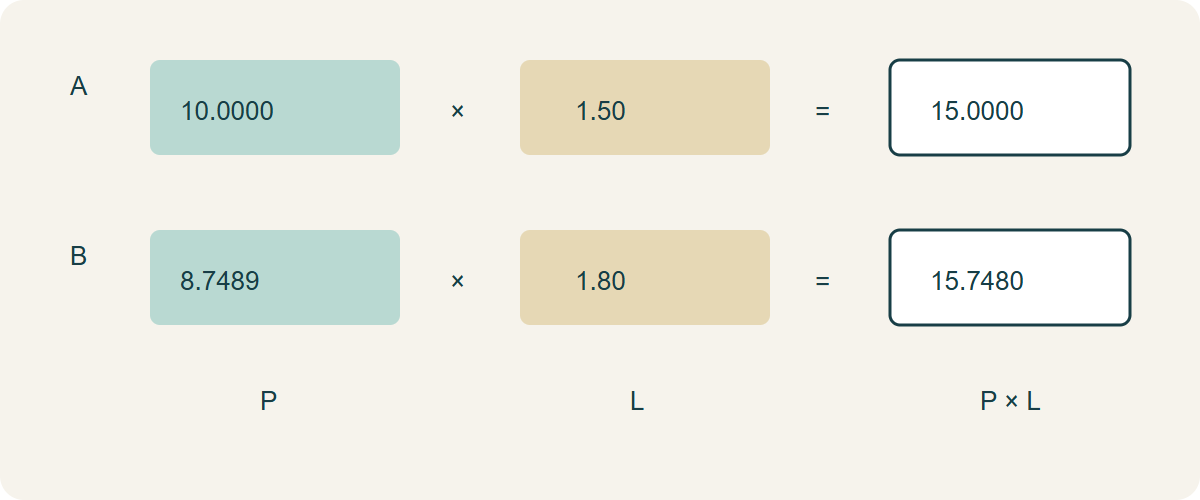
Assume all figures are illustrative USD amounts for equally accepted finished fabrics on the same delivery-cost basis. Quote A is $10/m and its approved marker uses 12 m for 8 garments, or 1.50 m each. Quote B is $8/yd, equivalent to about $8.7489/m, but its approved marker uses 14.4 m for 8 garments, or 1.80 m each. Before additional costs, A uses $15.00 of fabric per garment and B approximately $15.7480.
The lower unit price B has the higher fabric cost in this example. This does not prove a universal advantage for A’s material: the different marker lengths are assumptions that must be demonstrated for the actual patterns and usable widths. If B can achieve a better verified layout, recalculate. Keep the accepted marker files so another pattern maker can independently check the inputs rather than trusting a percentage claimed in a quotation.
| Illustrative item | Quote A | Quote B |
|---|---|---|
| Original unit price | $10/m | $8/yd |
| Price converted to metre | $10.0000/m | $8.7489/m |
| Marker length / garments | 12 m / 8 | 14.4 m / 8 |
| Fabric per garment | 1.50 m | 1.80 m |
| Fabric cost before extras | $15.0000 | $15.7480 |
5. Add losses and charges once, with a defined basis
If the parties hypothetically add a 5% purchase reserve for losses outside the marker, A becomes 1.50 × 1.05 = 1.575 m and B 1.80 × 1.05 = 1.890 m per garment. At the example prices, the reserved fabric costs are $15.75 and approximately $16.5354. This reserve is not a measured loss rate. Identify its reason, such as unrepresented roll-end loss, and remove any part already included in the marker or supplier allowance.
For a fixed development charge F shared over Q agreed garments, the allocation is F ÷ Q. Keep that allocation separate from repeat fabric price, and clarify whether it is one-time, refundable or repeated with a revision. Decoration clearing, reattachment, special seam work and inspection can differ by fabric, so add verified quotes for relevant work rather than a generic premium. Do not allocate fixed cost over an optimistic sales forecast when the accepted production quantity is smaller.
6. Show uncertainty where it can change the decision
If width or repeat has not been approved, the consumption input is provisional. Request representative full-repeat material and compare a marker at the minimum accepted usable width. If loss after care matters, base the adjustment on a verified dimensional plan; a marker already prepared for the finished post-care state should not receive the same shrinkage allowance again. Keep assumptions and exclusions in a visible column beside the total.
Test sensitive inputs one at a time: a revised marker, different accepted quantity or newly quoted finishing cost. If the apparent saving disappears under a plausible validated layout, request better evidence before choosing. Avoid inventing a reject percentage from generic industry claims; defect maps and actual retained production records are stronger inputs. Financial arithmetic can be checked independently, but physical yield still requires representative material and a feasible cutting plan.
7. Turn the comparison into an actionable enquiry
Can cost per square metre replace a marker? It can screen quotes but cannot account for borders, one-way layout or seam matching by itself. Does cheaper fabric require worse quality? No; price and approved properties are separate. Can the final garment selling price be derived here? No; this calculation concerns the defined fabric and associated cost scope, not an entire business margin or a guaranteed commercial outcome.
Keep the unit-conversion sheet, original quotations, approved marker and stated cost exclusions together. Ask a second person to reproduce the conversions and garment count, then ask the pattern maker to confirm the physical layout. This separates arithmetic errors from design limitations and gives the supplier specific questions to answer when a revised fabric or width changes the comparison.
Discuss your embroidery project
Send All4Lace the required construction, accepted usable width, priority motifs, garment pattern or approved consumption, order quantity and quotation unit. Request separately stated development and special construction charges so costs remain comparable.
Contact Zhijin