Customization & Sampling
Can an Embroidery Motif Simply Be Resized? Four Checks Before Changing Size
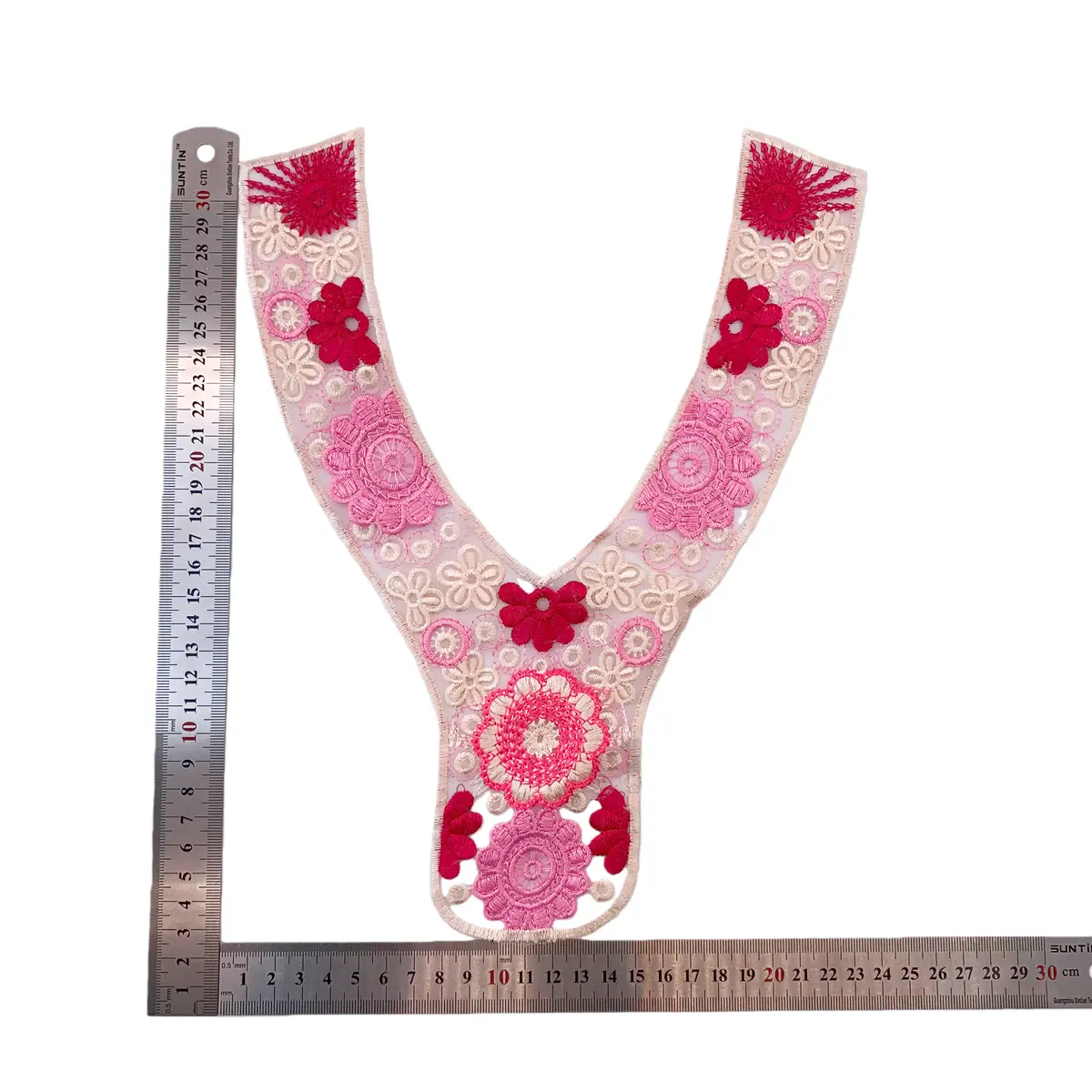
A request to make a motif smaller may concern a size range, cuff or neckline. Resizing artwork, processing stitches and fitting the decoration into a garment are different decisions. Define the intended change before asking for a percentage adjustment.
Separate motif size, spacing and arrangement
Provide current and target dimensions together. Identify whether you are changing the complete motif, one detail or the spacing between flowers. If overall length changes while individual flowers must retain their visual size, state that condition instead of asking for proportional stretching.
For example, changing a piece from 10 centimetres to 8 centimetres wide defines an outline target, not the suitability of every detail at that scale. This illustrates a brief, not a resizing range promised for Zhijin products.
Revisit detail and stitch requirements
When reducing size, review small gaps, fine outlines, lettering and motif connections. When enlarging, review the texture, spaces and edges that must remain. Circle essential features and identify details for which the digitizer may propose a revised treatment.
Wilcom distinguishes resizing design files that can regenerate stitches from resizing machine data. An artwork percentage alone therefore cannot confirm the result. Ask the factory to review the actual file and material rather than applying one universal scaling allowance.
Technical references
Return the revised motif to its garment position
Mark neckline, seams, folds and areas to avoid on the pattern. Check whether the revised decoration still fits those boundaries. Review paired designs, neckline curves and continuous-border joins within the same approval, instead of approving their external dimensions separately.
A size range may need more than one proportionally scaled drawing. Have the garment team specify dimensions that change with size and decoration that stays constant. Mark face, top, bottom and left/right orientation where relevant.
Create an approval record for the new size
Ask what the new sampling scope includes and whether digitizing, materials, quotation or scheduling changes. Do not assume a smaller motif has a price proportional to its area. Compare the actual development proposals rather than the geometry alone.
Review the new stitch-out on the intended base, recording finished dimensions, essential details and placement. Assign a version and retain the previous sample for comparison. Use the same approved size reference in subsequent orders and reorders.
- Current and target dimensions
- Details that must be preserved
- Garment position and paired orientation
- New sample version and quotation scope
Discuss your embroidery project
Send Zhijin the original motif, target dimensions, garment position and proposed base. We can clarify the change before discussing All4Lace references and revised-size sampling.
Contact Zhijin