Customization & Sampling
Lace Motif Direction and Mirrored Panels: Approve Left and Right Together
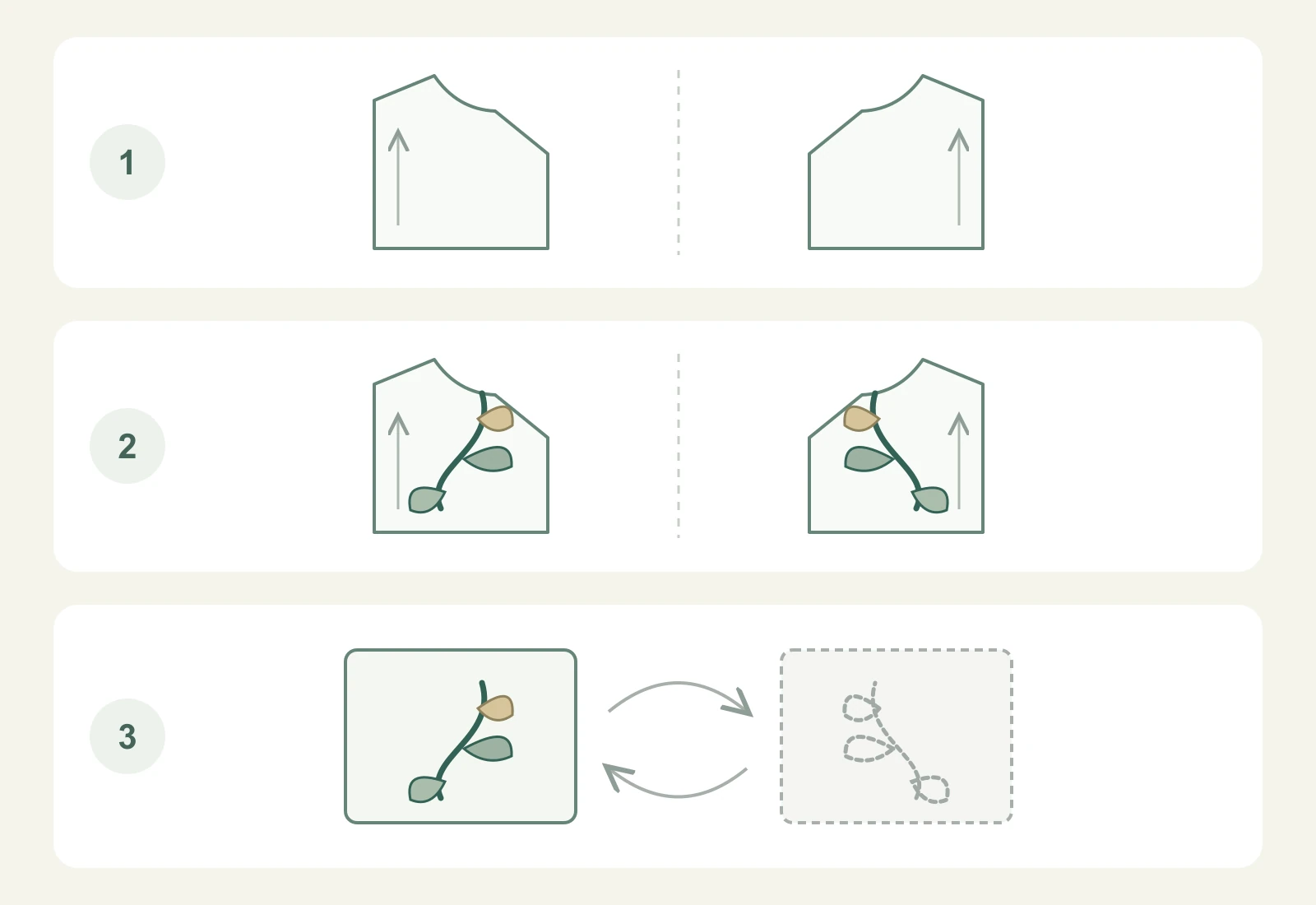
Matching left and right lace panels requires three separate decisions: the direction of the motif, the shape of each garment piece and whether the embroidery drawing itself should be mirrored. Flipping a paper pattern can produce an opposite panel shape, but it does not redraw an existing asymmetric flower. Turning the fabric over exposes its reverse. Approve the pair with both intended outward faces visible and the top of the garment clearly marked.
Keep direction, symmetry and panel shape separate
A motif can have a definite top without having a left and right version. An upright flower may need to point toward the shoulder on both panels, while an asymmetric vine may additionally need to curve toward the opening. Decide those requirements individually. A balanced arrangement can also be deliberately different on each side rather than an exact reflection.
Seamwork’s pattern-matching tutorial treats motif direction and flipping a cut-two paper pattern as separate layout steps. Apply that distinction to lace: an opposite garment outline and a reflected decoration are different targets. Mark the wearer’s left and right to avoid confusing them with the viewer’s left and right in a front photograph.
Technical references
Mirror the drawing without confusing the fabric face
Hatch’s official embroidery guide describes mirroring selected design objects horizontally or vertically. This is an editing operation on the design. Identify which drawing is original and which is reflected, and keep the garment-up arrow on both. Rotating a drawing to make a flower lean the other way may also turn its top downward.
For an existing embroidered material, look at the approved outward face first. If the plan proposes showing the reverse on one side, request a separate face approval for that panel. Compare the actual surfaces, edge treatment and visible stitching. A mirrored illustration and a reversed physical swatch should have different labels in the review pack.
Technical references
Work through a left-and-right front-panel example
Imagine two front panels for a jacket, with leafy stems beside the opening. The brief asks for both stems to rise toward the shoulders and both leaf clusters to bend inward. Start with paired paper outlines, then put the intended drawing on each outline.
| Proposal | What changes | What still needs checking |
|---|---|---|
| Flip the paper pattern | The outline used for the opposite garment side | The visible motif on each actual panel |
| Use the same drawing twice | Position changes; the motif retains its handedness | Whether both clusters face the opening |
| Use separately mirrored drawings | The decoration has opposite handedness | Both tops, garment sides and placement lines |
| Turn one fabric panel over | The other physical face becomes visible | Separate approval of that outward surface |
Review the pair at the finished opening
Lay both sample panels side by side as they will appear on the wearer, with their intended outward faces visible. Mark the finished opening and relevant seam or fold lines on a transparent overlay. Compare the leaf clusters against those lines, rather than judging their distance from an unfinished cut edge.
If the garment overlaps at the front, show the closed position as well as the open position. Part of one motif may be covered when the fronts close. Check the agreed focal points in both views and decide whether the design should mirror the visible decoration, align a shared feature or remain intentionally asymmetric.
Keep a paired approval set
Keep one full pair view, separate left and right views and close-ups of the agreed focal points. Label the wearer’s side, garment top, outward face and drawing version consistently. Ask the sample reviewer to check the pair before approving either panel alone.
A clear change note might say: retain the panel shapes and upward stems, but reflect the leaf cluster on the wearer’s right. That instruction isolates the drawing change. After revision, compare both outward faces again and preserve the approved pair together for a reorder.
- Mark wearer’s left/right and garment top.
- Identify original and mirrored drawing versions.
- Approve the outward face of each physical panel.
- Keep paired views with the finished opening and any overlap shown.
Discuss your embroidery project
Send All4Lace your left and right garment outlines, motif reference and marked outward faces so we can discuss a paired sample brief with the intended direction and mirror relationship.
Contact Zhijin