Materials & Applications
Scalloped Lace Edges: Single Borders, Double Borders and Placement
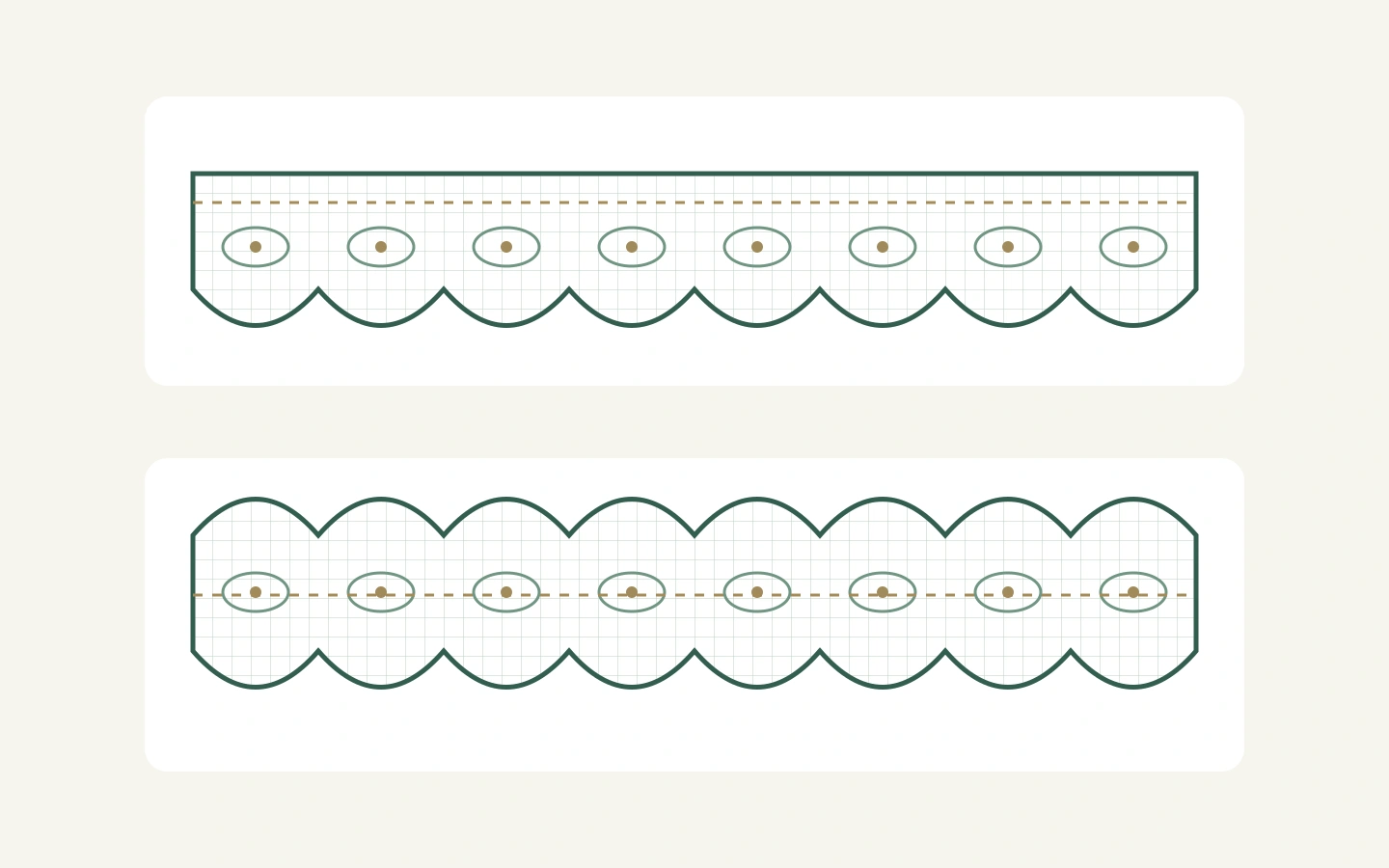
A scalloped lace edge follows a repeating outline of rounded or shaped projections rather than a straight line. Scalloped describes the edge: it does not identify the fibre, manufacturing method or stretch of the lace. The practical choice is where that outline should appear on the garment, which part will be attached and how the edge pattern meets a join.
A border shape, not a material category
A floral lace can have scallops, a straight edge or both. A scalloped border can sit on a narrow trim or along a wide fabric. These descriptions can therefore apply to the same item instead of competing with each other. Calling a material floral rather than scalloped does not tell you which one it is possible to use at a hem.
The finished outline also needs to be distinguished from the visible mesh around it. A sample may be supplied with net extending beyond an embroidered edge, or with an already trimmed decorative contour. Establish the delivered condition so the garment team knows what finishing remains. Neither a photograph nor the word scalloped establishes that condition on its own.
Single and double scalloped borders
A single scalloped trim commonly pairs a decorative outer edge with another side that can be incorporated into the garment. A double scalloped strip has a shaped outline on both sides. Do not assume that the two sides mirror each other: their scallops, motif direction or relative position can differ. Ask to see the whole strip, not just its more decorative half.
| Arrangement | Visual role | Placement question |
|---|---|---|
| One shaped side | Frames one exposed garment edge | Which side is attached and which is exposed? |
| Two shaped sides | Creates a decorative strip or insertion | Must both outlines remain visible? |
| Border on a wide fabric | Links an edge design to the fabric field | Which fabric direction carries the border? |
Peaks and valleys change the visible line
The widest projection is often called the peak; the recessed part is the valley. If two garment pieces meet with a peak on one side and a valley on the other, a continuous-looking border may break at the seam. A pattern maker can mark a chosen alignment point so the two pieces are positioned deliberately rather than starting wherever the sample was cut.
For a cuff, consider where the join falls around the wrist. For a front opening, compare the left and right edges together. Pattern designer Sew Projects demonstrates using a priority point to align scallops; that is a useful layout principle, not proof that every lace can be flipped to create a mirrored pair.
Technical references
A scallop does not make a strip follow every curve
The small curves along the decorative edge are different from the large curve of a neckline. A straight strip with beautiful scallops may still resist laying flat around a tight opening. Its ground, width and motif connections all influence the result. Stretch, if needed for the design, must be assessed in the selected material and attachment direction.
A shaped appliqué, a different border width or a revised placement may be worth comparing when a straight trim does not suit the line. Test the actual arrangement on the garment material before deciding. The aim is to preserve the intended edge without forcing the decorative strip into a shape that changes its motifs.
Separate the visible contour from the sewing line
The outermost scallop is the feature the viewer sees; the sewing line is the place where the trim is secured. They need not coincide. On a sketch, show the garment edge, the intended exposed lace and the attachment area as separate lines. This is especially helpful when a border is layered over an opaque fabric rather than extending beyond it.
A decorative finished edge may remove the need to fold that particular outline, but it does not finish every cut end, join or attached area. Those details depend on the design. Record the approved appearance at the join as well as along the uninterrupted border.
Questions about scalloped lace
Is scalloped lace always stretchy? No; edge shape and stretch are different characteristics. Can a double scalloped trim be split into two borders? Only after checking the middle construction and resulting edges on the selected design. Is a scalloped border always a separate trim? No; it can form part of a wider fabric. For usable fabric width and full-repeat cutting, continue to the dedicated cutting guide.
Discuss your embroidery project
Send All4Lace a reference edge and a sketch of its position on the garment. Mark the side that remains visible and any left-right matching requirement so the sample discussion starts with the border you intend to use.
Contact Zhijin