Materials & Applications
Picot, Scalloped or Eyelash Lace Edges? A Sample Approval Guide
A reference can have all three features. A picot is a small loop or projection made of thread. A scallop is the larger repeated curve of the edge. An eyelash finish leaves fine threads extending beyond the lace body. Describe the profile and the smaller details separately so the sample maker knows what to preserve.
Read the edge at two scales
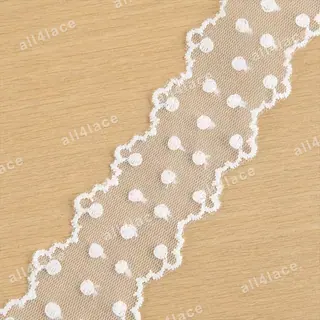
Lay the strip flat, face up, on a plain contrasting surface. Take one image showing the full width and several repeats. Take another close-up of the edge. Look for a thread loop that returns to the border, a sequence of curved peaks and valleys, and fine free ends. Look at both long edges before assuming they match. The white dotted mesh sample shown here illustrates the double wavy outline. Use it to compare shape only.
| Detail | What to look for | What to mark |
|---|---|---|
| Picot | Small thread loop or projection at the edge | The loops or points to keep clear of stitches |
| Scallop | Repeated arcs in the outer outline | Peaks and valleys against the garment edge |
| Eyelash | Fine free threads outside the lace body | The fringe that must remain free |
Mark where the detail will sit on the garment
On the full-width photo, mark the side that will remain visible and the intended stitch line. On the close-up, circle the exact loops or projecting threads that should remain outside that line. Lay one repeat over the actual shell and lining before cutting. A detail visible over a contrasting board can disappear over the chosen lining.
Approve a short stitched trial
Use the intended fabric layers and try the trim on the actual curve or straight edge. Check whether the attachment buries a loop, interrupts a scallop or traps eyelash threads. If the garment needs stretch, compare the required direction on the stitched sample and confirm its recovery separately. Record the approved reference, face and orientation, exposed width, and how the join should meet the next repeat. Keep the approved sample with the brief.
Discuss a sample
Send All4Lace a full-width photo, an edge close-up and a sketch marking the exposed edge. Ask which options can be sampled for your project.