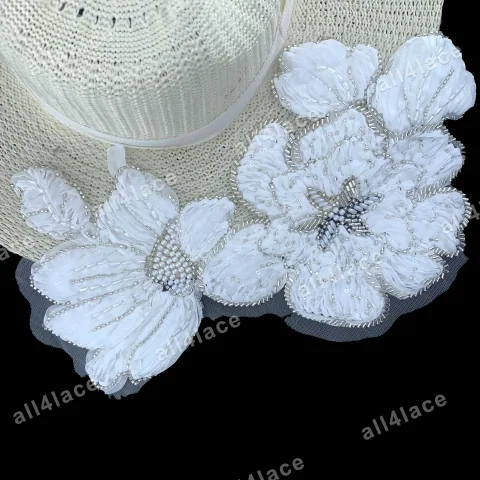
A lace appliqué can be supplied for sewing, supplied with a confirmed fusible backing, or sold without an attachment specification. A front photo may show the mesh and decoration but cannot establish how to fix the piece. Ask the supplier for the intended method for the exact reference and colour.
Ask what is actually on the reverse
Request a reverse photo and a written answer about any adhesive, carrier or backing. A backing that supports the embroidery may have a different function from an adhesive that bonds to the garment. With a sew-on reference, mark where the sample can take stitches without piercing beads or flattening raised details.
Separate positioning from the finished bond
Basting or a compatible positioning aid holds the motif while you work. Confirm which method is intended to keep it in place during wear and care. Adhesive instructions vary by product. Vlieseline describes a heat-activated web on a paper carrier, and Therm O Web lists distinct sewable and no-sew products. Use the directions for the exact backing rather than copying a temperature from another sample.
Sources & further reading
Compare trials on the intended layers
Use offcuts of the same shell and lining. Keep an untreated reference and identify the trial pieces. For a confirmed fusible system, follow its instructions and the garment material limits. After cooling, compare edge lift, stiffness, visible marks and distortion. For a sewn sample, check which areas take stitches and whether the motif still lies as intended. Repeat the review after the agreed care treatment before committing to bulk.
Discuss a sample
Send your motif reference and the intended base fabric to All4Lace. Include a close view of the reverse if you have one, the garment position, and the proposed care method.